
If you have noticed damp patches on your basement walls, a musty smell that never quite goes away, or white chalky deposits forming on the brickwork, your basement is telling you something important. Water is getting in. The question is not whether to deal with it, but which solution is right for your property.
Basement tanking is one of the most widely used waterproofing methods in the UK, and for good reason. When it is specified correctly and installed by a qualified professional, it creates a robust, physical barrier that stops water from penetrating your below-ground structure. But it is also a solution that fails spectacularly when it is mis-applied or when corners are cut.
This guide covers everything you need to know: what basement tanking actually is, how the process works from start to finish, which situations it is genuinely suited to, how much it costs in 2025, and when a different approach might serve you better.
What Is Basement Tanking?
Basement tanking is the process of applying a continuous waterproof barrier, either internally or externally, to the walls and floor of a below-ground structure to stop water ingress. The barrier is typically formed using a cementitious slurry, a polymer-modified render, or a sheet membrane, all designed to resist the hydrostatic pressure that groundwater exerts against your basement walls.
Under the British Standard BS 8102:2022 (Protection of Below Ground Structures Against Water Ingress), basement tanking is formally classified as Type A Barrier Protection. This distinguishes it from Type B (structurally integral waterproofing, built into the concrete itself) and Type C (cavity drain systems that manage water rather than block it).
The term ‘tanking’ comes from the idea of making a space as watertight as a tank. In practice, this means treating every surface, including the critical wall-to-floor junction, with a product that bonds directly to the masonry and resists water from outside pushing inward. This inward pressure is known as negative hydrostatic pressure, and it is one of the main reasons why correct surface preparation and application technique matter so much.
Important distinction: Basement tanking and basement waterproofing are not the same thing. Waterproofing is the broader category covering all three BS 8102 types. Tanking is specifically the barrier approach within that category.
Types of Basement Tanking: Internal vs External
There are two main approaches to tanking a basement, and the right one depends on the age of your property, the level of water pressure, and whether excavation is practical.
Internal Tanking
This is by far the most common method used in the UK, particularly for existing properties and cellar conversions. The waterproof coating or slurry is applied to the inner faces of the basement walls and floor. It is less disruptive than external tanking because it does not require excavation around the building’s foundations.
Internal tanking works best where the substrate is structurally sound, free of active water flow, and where ground pressure is moderate. It is the preferred choice for Victorian and Edwardian properties, terraced houses, and cellars being converted into usable living space.
External Tanking
External tanking involves applying the waterproofing membrane to the outer face of the basement walls, directly against the soil. It offers superior protection because it stops water at the point of contact with the structure rather than at the internal face, but it requires full excavation around the perimeter of the building.
Due to the excavation costs and disruption involved, external tanking is most commonly used on new-build projects, major basement conversions, or properties where internal access is extremely limited. It costs significantly more, typically between £100 and £200 per square metre.
Basement Tanking Methods at a Glance
| Method | Type (BS 8102) | Typical Cost (per m²) | Best For |
|---|---|---|---|
| Cementitious Slurry (Internal) | Type A | £40 – £80 | Existing cellars, Victorian homes, moderate water pressure |
| Sheet/Bitumen Membrane (Internal) | Type A | £60 – £120 | Retrofit projects, irregular masonry surfaces |
| External Membrane | Type A | £100 – £200 | New builds, major conversions, deep excavation access |
| Cavity Drain Membrane | Type C | £60 – £130 | High water pressure, habitable conversions, listed buildings |
Cost data sourced from industry surveys including PCA member contractors and tradesmencosts.co.uk (2025). Prices vary by region, basement size, and substrate condition.
How Basement Tanking Works: The Step-by-Step Process
Understanding the process helps you assess whether a contractor is doing the job properly. Every legitimate tanking project follows a clear sequence, and shortcuts at any stage typically mean failure down the line.
Step 1: Professional Survey and Design
Before a single drop of slurry is mixed, a qualified surveyor, ideally holding the CSSW (Certificated Surveyor in Structural Waterproofing) credential from the Property Care Association, must assess the basement. They identify the source and type of water ingress, evaluate the substrate condition, measure the water table risk, and specify the correct system under BS 8102:2022.
Step 2: Surface Preparation
This is the most critical stage of the entire process. Any existing paint, plaster, old render, bitumen coatings, or salt deposits must be completely removed, stripping back to the raw masonry or concrete substrate. Any cracks or defective mortar joints are raked out and repaired. Active water seepage points, often called water stops, are plugged with fast-setting hydraulic cement before the tanking layer is applied.
Inadequate surface preparation is the single most common reason why basement tanking fails. Water will always find and exploit the weakest point, which is usually where prep was skipped.
Step 3: Wall-to-Floor Junction Treatment
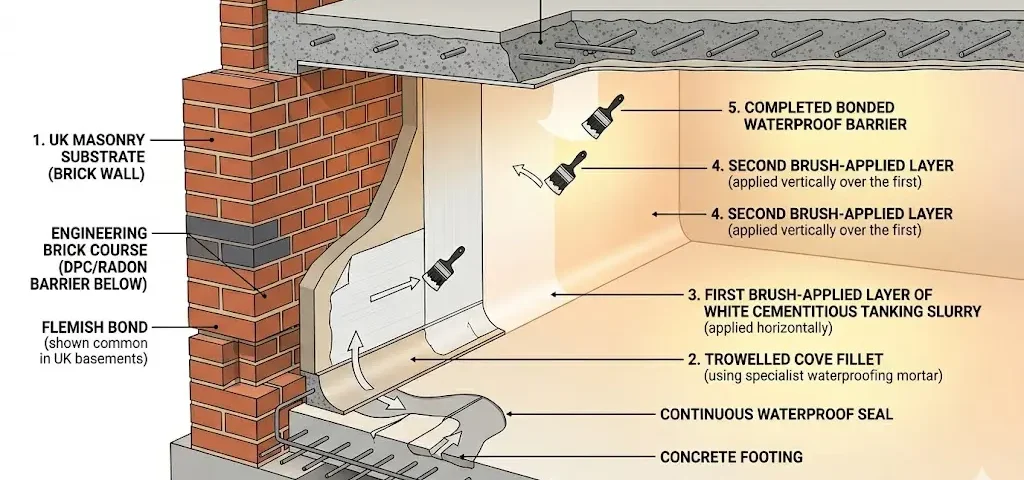
The internal angle between the wall and the floor, known as the cove or fillet, is the highest-risk point in any tanking system. A cementitious cove or angle fillet is formed here to create a smooth, continuous transition between the two surfaces, eliminating the sharp corner where membranes can crack or delaminate.
Step 4: Applying the Tanking Slurry or Membrane
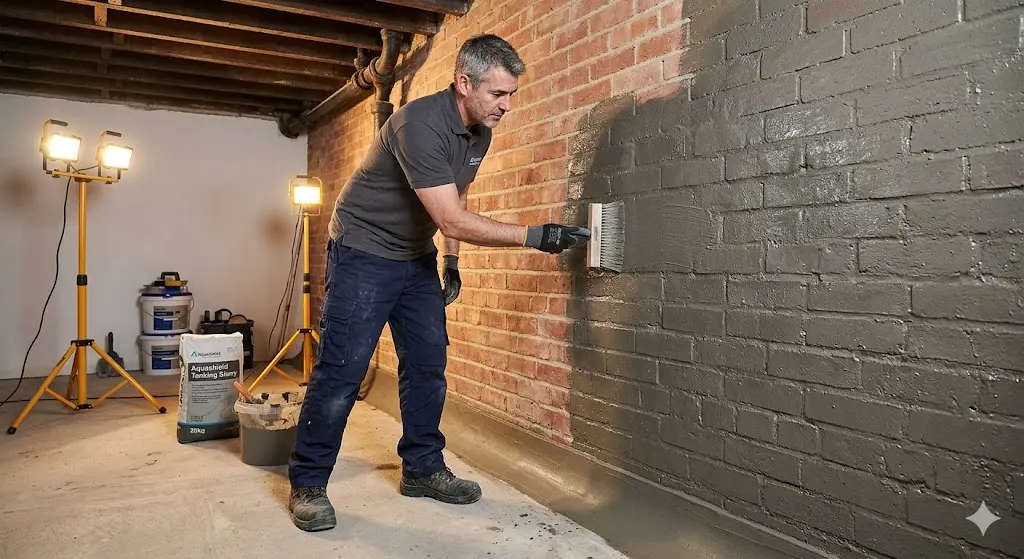
For cementitious systems, the slurry is typically mixed from a Portland cement-based powder (such as Vandex BB75, Sika-1 Pre-Bagged, or equivalent BBA-certified products) and applied in two coats by brush, at right angles to each other, achieving a minimum of 2mm dry film thickness. The surface is pre-dampened before the first coat, and each coat must be fully cured before the next is applied.
For sheet or liquid-applied membranes, the product is rolled, sprayed, or bonded to the substrate according to the manufacturer’s instructions. Laps, overlaps at junctions, and penetrations for pipes or services require special detailing to maintain continuity.
Step 5: Quality Checks and Sign-Off
Once complete, a reputable contractor will carry out thickness checks, visual inspections of all junctions and penetrations, and issue a guarantee backed by an insurance-backed warranty (IBW). Any system installed to BS 8102:2022 by a PCA-member contractor should come with a minimum 10-year guarantee.
How Much Does Basement Tanking Cost in the UK?
According to current industry data, the average cost of basement tanking in the UK ranges from £100 to £125 per square metre for a complete installation, including labour and materials. For a standard 5m x 4m basement with 3m-high walls (approximately 74m² of treated surface), this equates to a total project cost of £7,400 to £9,250.
However, several factors move that figure significantly:
- Basement size and layout: Larger or more complex basements with multiple rooms, awkward access points, or unusual shapes cost more per metre to treat.
- Water pressure level: If the basement sits partially below the water table, the contractor needs to manage active hydrostatic pressure, which often requires additional drainage channels, sump chambers, and pumps, adding £500 to £2,000 or more.
- Substrate condition: Crumbling mortar, old bitumen coatings requiring sandblasting, or extensive crack repairs can push preparation costs up considerably.
- Location: Labour rates in London and the South East are materially higher than the UK average.
- System type: External tanking requiring excavation is the most expensive option, often £100 to £200 per m².
- Habitable use: Converting the space to a Grade 3 habitable room under BS 8102:2022 requires a higher specification, often a combined Type A + Type C system, and compliance sign-off from a CSSW-qualified designer.
Typical Cost Ranges by Project Size (2025 UK Estimates)
| Project Size | Surface Area | Estimated Cost Range | Likely System |
|---|---|---|---|
| Small cellar (storage only) | ~20 – 30 m² | £2,500 – £5,000 | Internal cementitious tanking |
| Medium basement (1-2 rooms) | ~50 – 75 m² | £6,000 – £10,000 | Internal tanking + drainage |
| Large basement conversion | ~100+ m² | £12,000 – £25,000+ | Combined Type A + Type C system |
| External tanking (new build) | ~80 m² walls | £8,000 – £16,000 | External membrane + drainage |
These are indicative ranges only. Always obtain at least three written quotes from PCA-registered contractors.
Related Read: Why You Should Hire a Professional Waterproofing Consultant in the UK
When Should You Use Basement Tanking?
Basement tanking is the right solution in several clearly defined situations. It is not a universal fix, and understanding where it works best helps you avoid expensive mistakes.
Use Tanking When:
- Your basement or cellar has a solid, structurally sound substrate and is experiencing low to moderate moisture penetration through the walls or floor.
- You are converting a storage cellar into a usable, dry space and the ground pressure is moderate, without a persistently high water table directly against the walls.
- You are working on an older Victorian or Edwardian property where the masonry is in good condition and the cause of ingress is lateral penetrating damp rather than active water flow.
- External waterproofing is not possible, for example because the property is in a terrace or has no practical excavation access.
- You need a cost-effective, faster-installation solution for a lower-risk basement environment.
Consider a Different Approach When:
- The basement regularly floods during heavy rainfall or groundwater surges. Active flooding demands a Type C cavity drain system with sump and pump, not a barrier system.
- The structure has significant cracks, ongoing movement, or poor-quality masonry. Tanking requires a sound substrate to bond to. Applying slurry over a failing wall simply delays and multiplies the problem.
- You are converting the space to Grade 3 habitable use under BS 8102:2022. The standard recommends a combined approach, typically Type A tanking backed up by a Type C cavity drain system, for the highest reliability.
- The property is a listed building or in a conservation area. Here, a CSSW specialist must design the system, and cavity drain membranes are often more appropriate because they are reversible and non-destructive.
- The water table sits consistently above your basement floor level. In this case, a tanking system alone will be fighting the pressure 24 hours a day, and a cavity drain system is almost always the more durable long-term answer.
Basement Tanking vs. Cavity Drain Membranes: Which Is Better?
This is one of the most common questions homeowners and property managers ask, and the answer is: it depends on your specific situation. Neither system is universally superior. Each addresses water differently.
Tanking (Type A) tries to stop water entering the structure altogether. It blocks the moisture at the surface of the wall. This works well when the pressure is manageable and the substrate is sound, but if the barrier is breached, through a crack, a missed junction, or substrate movement, water finds its way through and there is no secondary layer of protection.
Cavity drain membranes (Type C) take a different philosophy. Rather than blocking water, they accept that some moisture will eventually find a way through any structure and manage that water safely by channelling it to a sump and pump system. This is why BS 8102:2022 recommends cavity drain as the preferred system for Grade 3 habitable spaces, and why most major UK building insurers require a maintainable Type C system for warranty purposes.
For the highest level of protection, particularly in higher-risk properties, a combined approach is recommended: Type A tanking as the primary barrier, backed by a Type C cavity drain system as a failsafe. This dual-system approach is now strongly indicated by BS 8102:2022 for Grade 3 and Grade 4 applications.
Related Read: Why You Should Hire a Professional Waterproofing Consultant in the UK
Why DIY Basement Tanking Usually Fails
Tanking products are available in builders’ merchants and online, and it might be tempting to treat a leaky cellar yourself. In practice, DIY basement tanking fails at an extremely high rate, and for entirely predictable reasons.
- Surface preparation, the most critical stage, is nearly always underestimated. Removing all salts, paint, and loose render and achieving a perfectly sound substrate requires specialist equipment and trained judgement.
- Water stop injection at active seepage points requires hydraulic cement and the skill to work quickly before water pressure pushes the product out.
- The wall-to-floor cove must be formed correctly. A missed or poorly shaped junction is the primary failure point in any tanking system.
- Application thickness and curing windows are critical. Manufacturers specify precise coverage rates and minimum curing times between coats that are easy to underestimate on a real job.
- A DIY installation will not come with an insurance-backed guarantee, and without a CSSW-signed design certificate, the system may not satisfy mortgage lenders, insurers, or future buyers if you sell the property.
The cost of having a professional re-tank a basement that has already been unsuccessfully DIY-treated is invariably higher than having it done right the first time, because all the previous work has to be stripped back.
How to Choose a Basement Tanking Contractor in the UK
The quality of the contractor matters more than almost any other variable in a tanking project. Here is what to look for:
- PCA membership: The Property Care Association (PCA) is the main professional body for structural waterproofing and remedial work in the UK. Member contractors are regularly vetted.
- CSSW qualification: The design of a BS 8102-compliant waterproofing system should be signed off by a Certificated Surveyor in Structural Waterproofing (CSSW). Ask for their qualification number.
- BBA-certified products: The contractor should specify products certified by the British Board of Agrément or with equivalent European Technical Assessment (ETA) credentials.
- Insurance-backed guarantee: Any guarantee worth having is underwritten by a third-party insurer, so it is still valid if the contractor ceases trading.
- Written specification: Before work starts, you should receive a written design specification referencing BS 8102:2022, detailing the system type, products to be used, and the BS 8102 grade being achieved.
Frequently Asked Questions About Basement Tanking
Q: How long does basement tanking last?
A professionally installed cementitious tanking system on a sound substrate can last 20 to 30 years or more. Most PCA-registered contractors offer a 10-year insurance-backed guarantee. Longevity depends heavily on substrate preparation quality, the absence of structural movement, and whether the system is inspected and maintained as recommended.
Q: Does basement tanking add value to a property?
Yes, in most cases. Waterproofing a damp or wet basement removes a significant flag on a surveyor’s report, which can otherwise cause mortgage lenders to withhold funds or buyers to reduce their offer. Converting a basement from damp storage to dry, habitable space with a certified waterproofing system can meaningfully increase a property’s usable floor area and market value.
Q: Can you tank a basement from the inside only?
Yes, internal tanking is the most common approach for existing properties in the UK and is entirely effective when the system is correctly specified and installed. The main limitation is that it must resist negative water pressure pushing inward, which is why surface preparation and product selection are so important. If water pressure is very high or the water table sits above the floor, internal tanking alone may be insufficient, and a combined Type A plus Type C system is advisable.
Q: What is the difference between tanking and damp proofing?
Damp proofing broadly refers to measures that manage or reduce moisture in walls, typically through chemical injection damp-proof courses (DPC) for rising damp or vapour control layers. It is designed for above-ground walls. Basement tanking is specifically engineered to resist lateral water pressure and hydrostatic pressure in below-ground structures. They are different treatments for different problems, and applying damp proofing treatments alone will not solve a basement water ingress problem.
Q: Do I need planning permission to tank my basement?
In most cases, no planning permission is required for waterproofing an existing basement. However, if the work is part of a basement conversion that changes the use or extends the habitable floor area, permitted development rules or full planning consent may apply depending on your local authority. Building Regulations approval is required whenever you are creating a new habitable room below ground. Always check with your local planning authority before starting a conversion project.
Q: How long does it take to tank a basement?
A straightforward internal cementitious tanking job on a single-room basement typically takes two to four days, not including the curing period before finishing coats can be applied. Larger projects, those requiring extensive preparation, or jobs involving both Type A and Type C systems will take longer. Your contractor should provide a clear programme before work begins.