
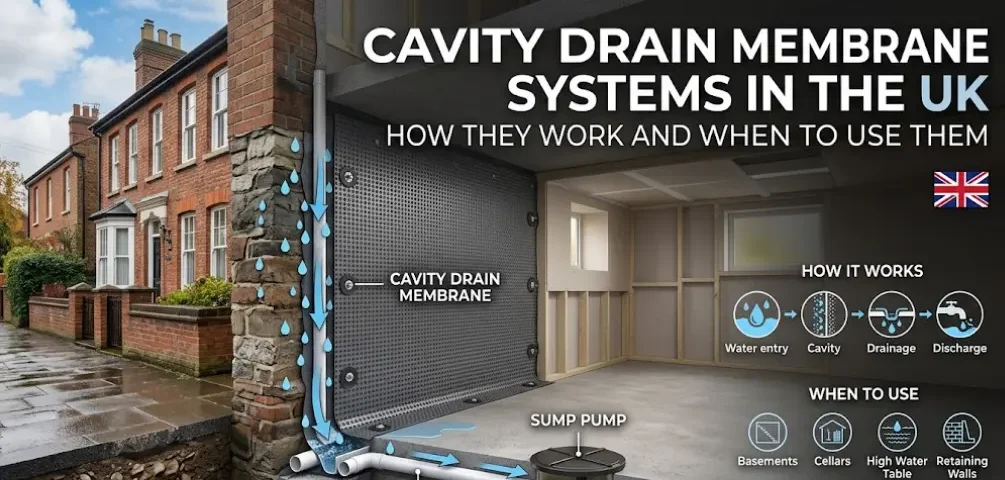
If you are converting a basement, waterproofing an existing cellar, or dealing with persistent water ingress below ground, the cavity drain membrane system is almost certainly the solution your specialist will recommend. It is the most widely used waterproofing approach for retrofit basements across the UK, it is the system most commonly required to achieve Grade 3 habitable environments under BS 8102:2022, and when correctly specified and installed, it is one of the most reliable long-term waterproofing solutions available.
This guide explains exactly how cavity drain membrane systems work, what all the components are, what they cost in 2025, when they are the right choice and when they are not, and how to make sure the system you get is correctly designed and installed.
What Is a Cavity Drain Membrane System?
A cavity drain membrane system, also called a Type C waterproofing system under BS 8102:2022, is an internal water management system for below-ground structures. Unlike tanking (Type A), which tries to stop water from entering the structure entirely, a cavity drain system accepts that water may enter and manages it safely rather than trying to block it under pressure.
The system works by fixing a studded high-density polyethylene (HDPE) membrane to the internal face of basement walls and laying a heavier version across the floor. The studs on the membrane create a discrete cavity between the membrane and the structural wall or floor. Any water that penetrates the structure enters this cavity, flows down behind the membrane under gravity, collects in a perimeter drainage channel at floor level, and is directed to a sump chamber where a submersible pump discharges it to a suitable external drain.
The result is a dry internal surface that can be plastered, dry-lined, or finished in any way you choose, with the water management system hidden behind it and fully accessible for maintenance through inspection points and a serviceable sump chamber.
The Four Components of a Cavity Drain System
A complete, BS 8102:2022-compliant cavity drain system for a habitable basement in the UK consists of four integrated components. Each one must be correctly specified, sized, and installed for the system to perform reliably.
1. Cavity Drain Membrane
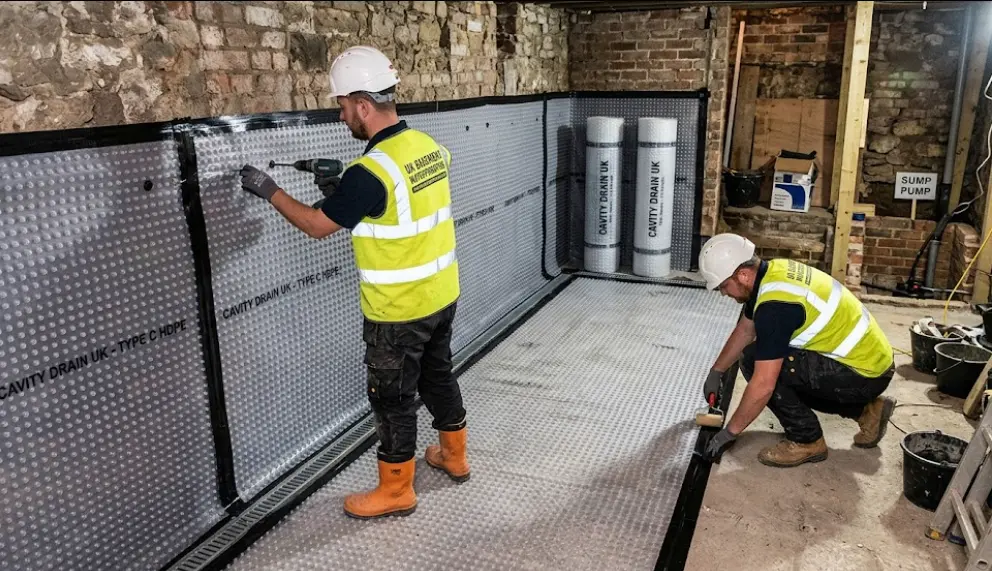
The membrane is the core element. It is an HDPE or polypropylene sheet with a studded or dimpled profile. Wall membranes typically use 8mm studs, which create an 8mm air cavity between the membrane and the wall surface. Floor membranes use 20mm studs to handle the additional load of a floor screed while still maintaining the drainage void beneath.
The membrane is fixed using sealed mechanical plugs that go through the membrane into the substrate, with waterproof tape sealing all joints, corners, and overlaps. Continuity is critical, any unsealed joint is a point of failure. The membrane wraps from the floor, up the walls, and is terminated at the correct height with a perimeter edge seal.
2. Perimeter Drainage Channel
A pre-formed drainage channel is set into a chase cut around the perimeter of the floor slab. It sits at the base of the wall membrane and collects water flowing down behind it. At regular intervals along the drainage channel, jetting points are installed. These give maintenance engineers access to flush the channel clear of any sediment or blockage without disturbing the finished floor or wall surfaces.
The drainage channel works entirely by gravity, directing all collected water toward the sump chamber. On larger or more complex basements, multiple drainage runs and sump locations may be required to ensure all areas drain effectively.
3. Sump Chamber and Pump
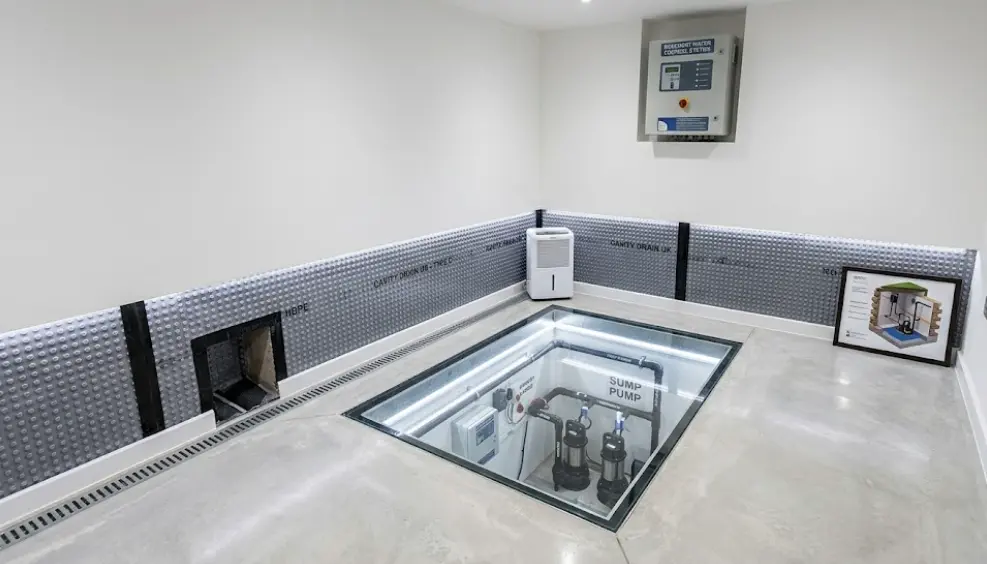
The sump chamber is typically a pre-formed plastic or concrete unit set into the floor slab at the lowest point of the drainage system. A submersible pump sits inside the chamber and activates automatically via a float switch when the water level rises. The pump discharges through a non-return valve to an external drain.
For any habitable Grade 3 environment, a dual-pump system with battery backup is strongly recommended. A single pump with no backup leaves the entire system vulnerable to pump failure or power cut. The cost difference between a single-pump and a dual-pump setup is modest, typically £800 to £1,500, compared to the damage a flooding event causes. A high-water alarm that alerts the property owner if water reaches a critical level is also standard practice on well-specified systems.
4. Control and Telemetry Systems
On commercial projects and increasingly on higher-value residential installations, modern cavity drain systems include electronic monitoring and telemetry that provide real-time status alerts for the pump, battery backup charge level, and water ingress volume. For property owners or asset managers who cannot check the sump regularly, remote monitoring gives early warning of any issue before it becomes a flood.
Key fact: A well-specified cavity drain system does not rely on perfect waterproofing of the structure. It manages water that enters. This makes it inherently more forgiving than tanking, where any single breach allows water to build up with no way out.
Cavity Drain vs Tanking: Which Is Better?
This is the most common question property owners ask. The honest answer is that for the majority of retrofit basements and cellar conversions in the UK, a cavity drain system is the more reliable choice. Here is why:
- Tanking fails under hydrostatic pressure. Cementitious tanking applied to the internal face of a basement wall is working against the water pressure from the outside. If there is any defect, crack, or poorly prepared substrate, water will find it and push through. Once water gets behind tanking, it has nowhere to go and the system fails.
- Cavity drain manages pressure rather than fighting it. By accepting that water may enter and channelling it away, the system never allows hydrostatic pressure to build up against the internal structure. The air gap also allows the wall substrate to breathe and gradually dry out, which is particularly important in older or heritage properties where rigid waterproof coatings are inappropriate.
- Cavity drain is maintainable and repairable. If a section of membrane is damaged, it can be accessed and repaired without demolishing the entire wall finish. The sump pump can be serviced, repaired, or replaced without any structural intervention. Tanking, once covered with finishes, is essentially inaccessible.
- Tanking has a role as part of a combined system. For Grade 3 habitable environments under BS 8102:2022, combining a Type A cementitious render or external membrane with a Type C cavity drain system gives the redundancy the standard recommends. The Type A layer provides primary resistance; the Type C layer manages anything that gets through.
When Is a Cavity Drain System the Right Choice?
A cavity drain membrane system is the preferred and most widely specified solution in the following situations:
- Retrofit cellar conversions. Where external access is not available, a Type C internal system is the practical standard. It works on brick, stone, blockwork, and concrete substrates and does not require the structural intervention that other approaches need.
- Habitable basement rooms. Any space intended as a bedroom, home office, gym, or living area requires Grade 3 protection under BS 8102:2022. A correctly specified cavity drain system with dual-pump sump is the most reliable way to achieve and maintain this grade.
- High or variable water table sites. Sites where the water table rises seasonally or after heavy rainfall place constant hydrostatic pressure on the structure. A cavity drain system manages this dynamically rather than relying on a barrier that may eventually fail under sustained pressure.
- Historic and listed buildings. Rigid barrier systems are not suitable for older masonry buildings, which need to breathe. A cavity drain membrane is mechanically fixed rather than chemically bonded, causes minimal disturbance to the existing fabric, and is fully reversible.
- Where a previous waterproofing system has failed. When tanking or another barrier system has failed and remedial work is required, retrofitting a cavity drain system is often the most cost-effective and reliable solution, since it works regardless of the condition of the substrate behind it.
Cavity Drain Membrane System Costs in the UK: 2025 Guide Prices
The cost of a cavity drain membrane system depends on the size of the basement, the complexity of the layout, access conditions, and the sump specification required. Below is a component-by-component cost breakdown based on current UK market data.
Cavity Drain System Component Costs: UK 2025 Guide Prices
| Component | What It Includes | Typical UK Cost (2025) | Notes |
|---|---|---|---|
| Wall cavity drain membrane | HDPE studded sheet, fixings, sealed plugs, waterproof tape at joints | £25 to £45 per m² | 8mm stud for walls |
| Floor cavity drain membrane | Heavier HDPE membrane laid under screed, perimeter channel | £20 to £35 per m² | 20mm stud for floors |
| Perimeter drainage channel | Pre-formed drainage conduit set into floor perimeter, jetting points | £50 to £80 per m run | Gravity-fed to sump |
| Single sump and pump | Sump chamber, submersible pump, alarm, non-return valve | £1,000 to £2,000 | Per pump unit |
| Dual-pump with battery backup | Two pumps, battery backup, high-water alarm | Add £800 to £1,500 | Recommended for Grade 3 |
| Full installed system (medium basement) | All of the above, labour, preparation, 5m x 5m example | £4,000 to £8,000 | Subject to site survey |
Guide prices exclude VAT. Based on industry data from MPS Concrete, Permagard, and Checkatrade 2025. Actual costs depend on substrate, access, and specification.
For a 5m x 5m basement with 2.4m high walls, approximately 62m² of surface area, material costs alone run to around £1,500 to £2,500 for the membrane components. Full installed costs including labour, drainage channel, and a single-pump sump typically fall between £4,000 and £8,000. Upgrading to a dual-pump system with battery backup adds £800 to £1,500 to that figure, and is money well spent for any space intended for habitable use.
Annual maintenance of the sump and pump system is recommended and typically costs between £200 and £400 per year, including inspection of the pump, flushing of the drainage channels, and testing of the float switch and alarm.
Why the Design Must Come Before the Installation
A cavity drain membrane system is only as good as its design. Critical decisions, where to position the sump, how many drainage runs to include, which membrane weight to specify for the floor loads involved, how to detail around door thresholds, pipe penetrations, and step changes in floor level, must all be resolved before installation begins. Getting these wrong leads to pooling, blocked channels, poorly supported finishes, or sump failures that could have been avoided.
Under BS 8102:2022, the waterproofing design must be produced by a named CSSW-qualified specialist with professional indemnity insurance. An independent design produced by a specialist who has no commercial interest in which products are used gives you the right system for your site, a document that satisfies building control and warranty providers, and a basis for obtaining competitive quotes from approved installers.
At CSSW Design, all cavity drain and combined waterproofing designs are produced by CSSW-qualified professionals, fully compliant with BS 8102:2022. The design includes CAD drawings, full junction details, and a written specification that approved installers can quote against accurately.
Get Your Cavity Drain System Right from the Design Stage
A cavity drain membrane system is one of the most reliable and widely used waterproofing solutions available for UK basements and cellars. But its performance over decades depends entirely on the quality of the design and installation. The right membrane weight, the correct sump sizing, the properly detailed junctions, the dual-pump backup, none of these happen by accident. They happen because a qualified specialist designed the system correctly from the start.
If you are planning a basement conversion, a cellar waterproofing project, or if you have an existing system that needs assessment, get in touch with the independent specialists at CSSW Design. Every design is produced by a CSSW-qualified professional, compliant with BS 8102:2022, and backed by professional indemnity insurance.
Frequently Asked Questions About Cavity Drain Membrane Systems in the UK
What is a cavity drain membrane system?
A cavity drain membrane system is a Type C waterproofing system under BS 8102:2022. It uses a studded HDPE membrane fixed to the internal face of basement walls and floors to create a drainage cavity. Any water entering the structure flows through this cavity into a perimeter drainage channel and is pumped out via a sump and pump system.
How does a cavity drain system differ from tanking?
Tanking (Type A) attempts to stop water from entering the structure by applying a waterproof barrier coating. A cavity drain system accepts that water may enter and manages it safely by channelling it to a sump and pump. Cavity drain is more forgiving of substrate imperfections, easier to maintain, and does not fail under sustained hydrostatic pressure the way tanking can.
Do I always need a sump pump with a cavity drain system?
In almost all cases, yes. The sump pump is what removes the water from the drainage system. The only exception is where passive gravity drainage to an external drain is feasible, which is rarely possible in most UK basement configurations. For habitable rooms, a dual-pump system with battery backup is strongly recommended.
How long does a cavity drain system last?
The HDPE membrane itself has a design life of 50 years or more. The sump pump typically lasts 5 to 10 years depending on usage and maintenance and should be replaced as part of a regular service programme. With correct annual maintenance, the overall system should last the full life of the building.
Can a cavity drain system be installed in an old or listed building?
Yes. Cavity drain membrane systems are the preferred choice for historic and listed buildings because they are mechanically fixed rather than chemically bonded, are fully reversible, and allow the original masonry to breathe. They do not require chemical injection or the application of cementitious coatings that would be inappropriate on lime mortar or historic stonework.
How much does cavity drain membrane cost per square metre in the UK?
Wall membrane materials typically cost £25 to £45 per m² supplied. Floor membranes cost £20 to £35 per m². A full installed system including membrane, drainage channel, sump, and pump typically costs £80 to £150 per m² of floor area, varying with basement size, complexity, and location.
Does a cavity drain system need maintenance?
Yes. The sump pump should be inspected and tested annually by a qualified service engineer, and the perimeter drainage channels should be flushed through periodically to prevent blockage. Most specialists recommend an annual maintenance contract costing £200 to £400 per year, which often includes emergency call-out cover.
Is cavity drain waterproofing compliant with BS 8102:2022?
Yes, when correctly designed and installed. BS 8102:2022 defines Type C drained protection and sets out the design and performance requirements for cavity drain systems. The design must be produced by a CSSW-qualified specialist and the system must achieve the performance grade appropriate to the intended use of the space.
Can a cavity drain system be combined with other waterproofing types?
Yes, and for Grade 3 habitable environments, combining Type C with Type A is strongly recommended by BS 8102:2022 to provide redundancy. A cementitious render or external membrane (Type A) provides the primary barrier, while the cavity drain system (Type C) manages anything that gets through, giving defence in depth.
How do I get a cavity drain system correctly specified for my project?
Appoint a CSSW-qualified independent design specialist before approaching any installer. CSSW Design provides fully independent, BS 8102:2022-compliant cavity drain and structural waterproofing designs for residential and commercial projects across the UK, backed by professional indemnity insurance.