
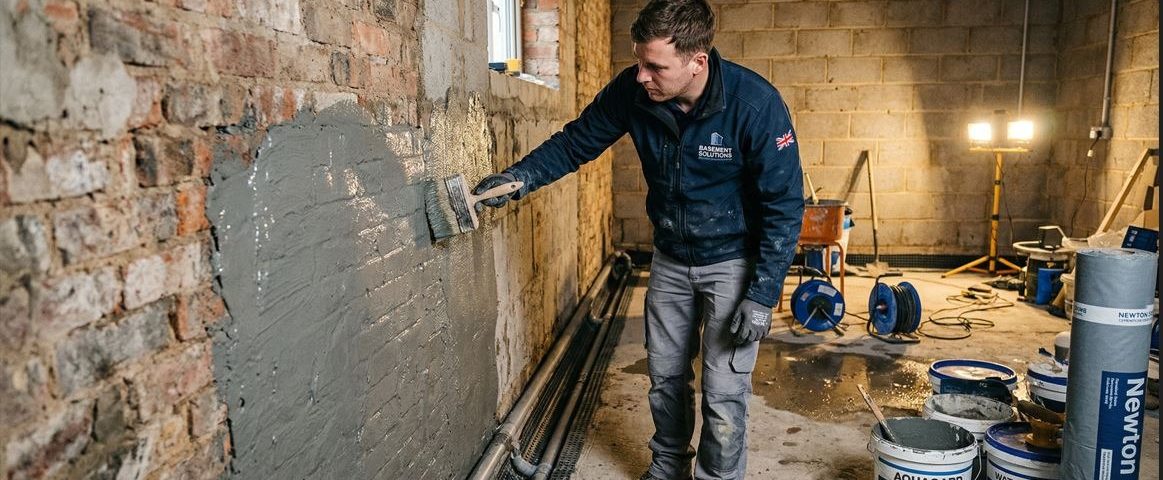
Basement waterproofing is not a simple job. It involves complex engineering, specialist materials, and strict regulations. Knowing how much does it cost to waterproof a basement starts with understanding what drives those costs not chasing a flat price.
This guide breaks down every major cost factor. It helps you budget accurately and avoid expensive mistakes.
What Affects Basement Waterproofing Costs?
Size and Layout
Larger basements cost more to waterproof. But size alone does not tell the full story. A small basement with many compartments, tight corners, and numerous walls costs far more than a simple open-plan space. Complex layouts need more materials, more labour, and more time. Simple square layouts with open floor plans sit at the low end of the cost scale.
System Type
There are three main waterproofing systems under BS 8102:2022.
Type A uses physical barriers like cementitious coatings or sheet membranes. It works on structurally sound masonry. It sits at the lower cost end.
Type B uses watertight concrete as the structure itself. It is common in new builds. The cost lands in the medium-to-high range.
Type C uses cavity drainage membranes and sump pump systems. It manages water rather than blocks it. It is one of the most reliable systems but carries a high initial cost.
Combined systems using Type B and Type C together offer the highest protection. They also carry the highest price tag.
New Build vs Retrofit
New builds cost less to waterproof. Engineers design the system from scratch. They have full external access and can apply membranes before backfilling.
Retrofit projects cost significantly more. Contractors work inside a confined existing space. They remove old failed systems, excavate by hand, and work around existing foundations. Every step is slower and harder.
Site Access
Restricted access inflates costs sharply. Urban basements particularly in dense cities often require materials carried down narrow stairwells. Heavy machinery cannot always reach the site. Parking permits, skip licences, and noise restrictions add to the budget. London basement waterproofing projects regularly carry these additional urban costs.
Groundwater Conditions
The geology beneath your property matters enormously. London Clay, for example, does not drain freely. It traps water against retaining walls and builds intense hydrostatic pressure. Sites on floodplains or near high water tables demand stronger, more engineered solutions. These conditions push costs into the highest tier.
Structural Condition
Old masonry often needs repair before waterproofing begins. Crumbling brickwork, ground salt contamination, and active cracks all require specialist treatment first. Heritage-listed properties add another layer of complexity. Conservation rules may restrict which methods are allowed, forcing bespoke solutions and raising costs further.
What Additional Costs Should I Budget For?
Sump Pump Installation and Maintenance
A Type C cavity drainage system requires a sump pump to evacuate collected water. A single pump is not enough. Industry best practice mandates dual pumps for redundancy. You also need high-level water alarms, electronic sensors, and a battery backup system for power failures.
These are not optional extras. They are essential components of a compliant system.
Ongoing maintenance is a real cost too. Domestic pumps need professional servicing at least once a year. High-risk environments need servicing every six months. Pumps typically last seven to ten years before replacement.
Damp Survey and CSSW Design Fees
A proper waterproofing design requires a specialist. BS 8102:2022 requires a Certificated Surveyor in Structural Waterproofing (CSSW) to lead the design process.
A CSSW-qualified professional conducts a thorough survey. This includes thermal imaging, moisture mapping, salt testing, and geotechnical analysis. Their design meets warranty and building regulation requirements. Skipping this step risks system failure, voided warranties, and reduced property value.
Enabling Works and Concrete Repair
The substrate must be prepared properly before any system is installed. This often means removing old tanking, repairing cracked concrete, and injecting cracks with specialist resin. In areas with calcium-rich groundwater, anti-lime coatings must be applied to drainage channels. Without this preparation, even a high-quality system will fail.
Why Are Cheap Basement Waterproofing Quotes Risky?
Poor Materials
Low-cost quotes usually rely on inferior materials. Cheap cementitious coatings crack under hydrostatic pressure. Thin cavity drain membranes compress and fail beneath floor screeds. Critical components like waterproof pipe collars and hydrophilic waterstops are often omitted entirely. These omissions create weak points that water will find.
Incomplete Waterproofing Systems
A cheap quote may install a cavity drain membrane with no sump pump. Or a single pump with no alarm and no battery backup. These are incomplete systems. They provide a false sense of security. When the pump fails during a storm, the basement floods.
BS 8102:2022 also requires inspection ports and rodding eyes for long-term maintenance. Cheap contractors regularly leave these out. When drains block, the only fix is to excavate the finished floor a costly and destructive remedial job.
Lack of Proper Design or Survey
Flat-rate quotes skip the site survey. They apply a generic system without assessing soil conditions, structural defects, or legal obligations. They rarely carry Professional Indemnity insurance. They are not registered with the Property Care Association (PCA).
When the system fails and without proper design, it will the property owner pays for everything. That includes investigation, demolition of failed works, and a full compliant reinstallation.
The cost of fixing a failed cheap job always exceeds the cost of doing it right the first time.
How Do You Get an Accurate Basement Waterproofing Quote?
Site Survey Process
An accurate quote begins with a forensic site survey. This is not a quick visual inspection. It involves mapping moisture levels across all masonry surfaces, thermal imaging to detect cold bridges, chemical testing for ground salts, and a structural assessment of all retaining walls and floor slabs. Local geotechnical data is also reviewed. Only after gathering this evidence can a contractor scope the works accurately.
Professional Assessment
The surveyor then matches the site data to the correct BS 8102:2022 environmental grade. This grade determines the type and complexity of the required system. The assessment also identifies legal obligations — such as Party Wall Act notices — that may affect the project timeline and cost.
Importance of Expert Inspection
Search for basement waterproofing near me and you will find many contractors. Not all are equally qualified. Insist on a CSSW-qualified surveyor. Their inspection aligns with PCA standards. Their design satisfies mortgage lenders, structural warranty providers, and building control bodies.
Expert involvement reduces cost surprises during construction. It also provides the legal documentation needed to protect your investment long term. A professional damp survey is the single most important step you can take before committing to any waterproofing project.
How Can You Plan Your Basement Waterproofing Budget?
No two basements are the same. A fixed-price budget based on square meterage is almost always wrong. Effective budgeting allocates capital across distinct phases: professional design fees, substrate preparation, membrane and drainage installation, electromechanical systems, and long-term maintenance. A contingency reserve is essential. Unexpected discoveries like unmapped drainage runs or hidden masonry decay are common below ground.
Affordable projects cover basic storage spaces (Grade 1a/1b). Minor dampness is tolerated. Interventions may include localized pointing repairs and simple Type A coatings on sound walls. No pumping systems are required.
Mid-range projects cover standard domestic basement conversions (Grade 2). No active water ingress is acceptable. The budget covers a full Type C cavity drainage system, dual-pump sump station, perimeter channels, and professional CSSW design fees. Moderate enabling works are also included.
Premium projects cover high-end residential and commercial spaces (Grade 3). No moisture whatsoever is permitted. Combined Type B and Type C systems are mandatory. Advanced electromechanical arrays including battery backup systems and cloud-based telemetry monitoring are standard. Urban logistics, Party Wall Act compliance, and HVAC integration add further cost.
Knowing which category your project falls into gives you a realistic financial framework to work within.
FAQs
How much does it cost to waterproof a basement? There is no single fixed price. The cost depends on basement size, system type, groundwater conditions, structural condition, and the target environmental grade. A professional CSSW survey is the only way to get an accurate figure for your specific site.
What is included in a waterproofing quote? A comprehensive quote covers professional survey fees, substrate preparation, membrane and drainage installation, sump pump systems with battery backup, regulatory compliance costs, and long-term insurance-backed guarantees. Any quote that omits these elements is incomplete.
Does new build waterproofing cost less than retrofit? Yes. New builds allow integrated design from the start, efficient external access, and no demolition of existing systems. Retrofit projects require confined manual working, removal of failed historical tanking, and complex enabling works. This makes retrofits significantly more expensive.
How often should sump pumps be maintained? Domestic systems require annual professional servicing as a minimum. High-risk environments and high-use residential basements need servicing every six months. Commercial systems in aggressive geological conditions require quarterly inspections. Regular maintenance protects the entire waterproofing system and ultimately the property itself.
Waterproofing cellars and basements is a precision engineering task. It protects one of your most valuable assets. Work with qualified specialists. Budget for the full scope. And never compromise on the quality of the design behind the system.