
Water finds a way in. In below-ground structures, it always does.
The question is not whether water will reach your basement walls. The question is what happens when it gets there. A cavity drain membrane system answers that question with a clear, proven solution.
This guide covers everything you need to know , how cavity drain systems work, when to use them, what BS 8102:2022 requires, and how to keep them running correctly.
What is a Cavity Drain Membrane?
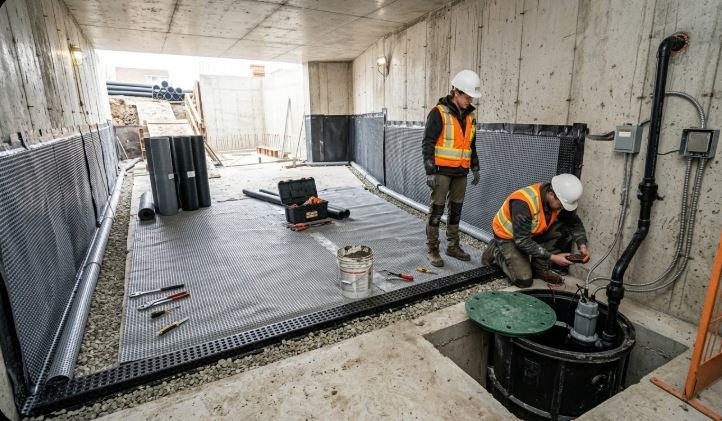
A cavity drain membrane is a thick, studded plastic sheet fixed to the internal walls and floor of a below-ground structure. It does not stop water from entering the wall. Instead, it controls where that water goes.
The studs on the membrane face the wall. They create a small air gap between the membrane and the wall surface. Water enters through the wall, travels down through that gap, and collects at the base of the wall in a drainage channel. From there, it moves to a sump chamber and gets pumped out.
In BS 8102:2022 terms, a cavity drain membrane is a Type C waterproofing system a water management system rather than a barrier system.
How Does a Cavity Drain System Work?
A cavity drain system has four components. Each one performs a specific job. They work together as a complete drainage circuit.
Step 1: The Membrane (Studded Surface and Air Gap)
The membrane is the first component. It is fixed directly to the internal face of the basement wall and floor.
The studded profile creates a drainage void of approximately 8mm between the membrane and the structure. Water that passes through the wall enters this void and flows downward under gravity. The membrane itself does not need to be watertight ,it just needs to be intact and correctly lapped at joints.
Step 2: Drainage Channels (Perimeter Collection)
At the base of the walls, a perimeter drainage channel collects the water. This channel sits under the floor slab or at floor level along the wall base.
It directs water from all four walls toward a single collection point. The channel is sloped to ensure flow. It prevents water from pooling behind the membrane.
Step 3: Sump Chamber and Pump System
The sump chamber is a sealed pit installed in the floor. All collected water flows into it.
A submersible pump sits inside the sump. When the water level reaches a set point, the pump activates automatically and discharges the water out of the basement. Most installations use a dual-pump system one primary pump and one backup to prevent failure.
The pump is the critical component of the entire system. Without it, the sump fills and the system stops working.
Step 4: Discharge to External Drain
The pump pushes water through a discharge pipe to a suitable external outlet. This is typically a soakaway, surface water drain, or external gulley.
The discharge point must be confirmed during the design stage. In some locations, discharge to a public sewer requires approval from the local water authority.
Why is Cavity Drain (Type C) the Most Popular UK Retrofit Solution?
In retrofit projects converting an existing basement or cellar Type C is the dominant choice. There are clear practical reasons for this.
External waterproofing (Type A) requires excavating around the outside of the structure. In a terraced house or urban plot, that is often impossible. Internal cavity drain systems require no external excavation.
Type C systems also tolerate structural movement. When a building settles slightly, a rigid tanking coat can crack. A studded membrane flexes without losing its drainage function.
Finally, cavity drain systems are repairable. If a section of membrane is damaged, it can be accessed and replaced without opening up the structure.
These three factors — no external access needed, tolerance of movement, and maintainability make Type C the practical default for UK retrofit basement waterproofing.
Cavity Drain Membrane vs Tanking (Type A): Which is Better?
Neither system is universally better. Each one suits different project types.
| Factor | Type C (Cavity Drain) | Type A (Tanking) |
| Best for | Retrofits, existing buildings | New builds, accessible new structures |
| External excavation needed? | No | Yes (for external application) |
| Tolerates structural movement? | Yes | No — prone to cracking |
| Maintainable? | Yes — accessible system | Difficult once plastered |
| Relies on pump? | Yes — pump failure is a risk | No mechanical components |
| Achieves Grade 3? | Yes, with correct design | Yes, with correct design |
| BS 8102 type | Type C | Type A |
For new-build basements, a combined Type B and Type C system is more common. For retrofitting an existing cellar or basement in a UK property, cavity drain is usually the right answer.
A CSSW-qualified designer should confirm the correct system for your specific project. Do not select a system without a formal waterproofing design.
Main Cavity Drain Membrane Manufacturers
Several manufacturers supply cavity drain membranes in the UK. They all produce studded HDPE membranes, but product specifications and system warranties differ.
Newton Waterproofing : one of the most widely specified brands in the UK. Newton 508 is a standard wall membrane. Newton offers full system warranties and has a large network of approved installers.
Delta Membrane Systems : Delta MS 20 is a widely used floor and wall membrane. Strong presence in the UK market. Offers both wall and floor variants for complete system coverage.
Visqueen : part of the RPC group. Produces cavity drain membranes as part of a broader damp-proofing product range. Often used in combination with other Visqueen products.
Wykamol : UK manufacturer with a full range of cavity drain products. Cavity Drain CMS8 is a common wall membrane. Offers guarantees through approved installers.
Platon : a Glatthaar product with strong European heritage. Platon P8 is used for wall applications. Good specification on new-build and retrofit projects.
Each manufacturer offers product-specific training and installer approval programmes. Always use an approved installer for the brand being specified.
What Grade of Waterproofing Can Cavity Drain Achieve?
BS 8102:2022 defines four waterproofing grades based on the intended use of the space.
A correctly designed and installed cavity drain system can achieve Grade 3 fully habitable ,when used as part of a combined system. This is the highest grade under BS 8102 and means the space is suitable for use as a bedroom, living room, or office.
For Grade 3, BS 8102:2022 recommends a combined Type B and Type C system for new builds, or a combined Type A and Type C system for retrofits. Type C alone is considered sufficient for Grade 2 and Grade 3 when backed by a CSSW-produced design that includes dual-pump provision and a maintenance schedule.
Type C cannot achieve any grade without a functioning pump and drainage circuit. The system must be maintained. This is a formal requirement under BS 8102:2022.
BS 8102:2022 Requirements for Type C Systems
The 2022 update to BS 8102 introduced explicit requirements for Type C systems that were not present in the 2009 version.
Key requirements include a formal written waterproofing design produced by a CSSW-qualified professional, dual-pump provision for Grade 2 and Grade 3 spaces, a written maintenance schedule provided to the building owner, and confirmation that the discharge point is suitable and approved.
The standard also requires that the building owner is informed in writing that the system requires regular maintenance. If the pump is not serviced and fails, the system fails. That responsibility now sits formally with the building owner after handover.
Failing to comply with these requirements can void structural warranties and create liability issues on sale or resale.
Cavity Drain Membrane Installation Process
Installation follows a defined sequence. Deviating from it risks system failure.
1. Prepare the substrate. Remove all loose render, plaster, and debris from the walls and floor. The membrane must be fixed to a reasonably clean, solid surface.
2. Fix wall membranes. The studded membrane is mechanically fixed to the wall using waterproof plugs. Horizontal joints must be lapped by a minimum of one stud row and sealed with the manufacturer’s specified tape.
3. Install perimeter drainage channels. Channels are fixed at the wall-floor junction before the floor membrane and slab are laid. They must be correctly sloped toward the sump location.
4. Excavate and install the sump chamber. The sump pit is formed in the floor. The chamber is set level and connected to the drainage channels.
5. Lay floor membrane and pour concrete. The floor membrane is laid over the drainage channels and sump. A reinforced concrete slab is then poured over it.
6. Install pump. The submersible pump is installed once the slab has cured. The discharge pipe is routed to the external outlet and tested.
7. Finish internally. A studded wall membrane can be dot-and-dab plastered or boarded over. The CSSW design specification will confirm the correct finish for the grade required.
How to Maintain a Cavity Drain System
Maintenance is not optional. BS 8102:2022 requires a maintenance schedule. Most system warranties are void without it.
Sump Pump Servicing Schedule
Service the pump every 12 months as a minimum. During servicing, check pump operation, clean the float switch, inspect the discharge pipe for blockages, test the backup pump independently, and confirm the alarm system is functioning.
In properties with high groundwater or regular pump activation, service every 6 months.
Keep a written service record. This is required for warranty compliance and is useful evidence if a dispute arises on sale.
Drainage Channel Flushing
Flush perimeter drainage channels every 2 to 3 years. Over time, fine silt and mineral deposits can partially block channels and reduce flow.
Flushing is done by rodding access points installed at the time of construction. If your system does not have rodding access points, raise this with your installer , they should be retrofitted.
Do not wait for the system to show signs of failure before flushing. Prevention is significantly cheaper than remediation.
How Much Does a Cavity Drain Membrane System Cost?
Costs depend on several project factors. These include basement size, water ingress level, system complexity, and installation requirements.
Every basement presents different conditions. Groundwater pressure, structural layout, and drainage design all affect the waterproofing approach. Because of this, installers must assess the site before recommending a system.
Additional components can also influence the design. Examples include sump chambers, pump systems, drainage channels, and internal wall finishes. High groundwater conditions or complex structures may require more advanced solutions.
The condition of the existing structure also matters. Surfaces in poor condition often require preparation work before installation. This may include repairs, cleaning, or structural adjustments.
For accurate planning, request a detailed assessment from a qualified waterproofing professional. Always obtain quotes from installers who work with a CSSW-qualified designer. A properly designed system ensures the waterproofing solution matches the specific risks of the structure.
Avoid selecting a contractor based on price alone. A complete waterproofing design should include the full scope of work, installation guidance, and compliance with BS 8102:2022.
FAQs:
Can I install a cavity drain membrane myself?
No. BS 8102:2022 requires installation by a competent, trained operative. Manufacturer warranties require approved installer status. DIY installation will not be covered by any guarantee.
Does a cavity drain system stop water coming in?
No. It manages water after it enters. The membrane captures water and directs it to the pump. It does not block water entry. This is why it is called a water management system, not a barrier system.
How long does a cavity drain membrane last?
HDPE membranes have a design life of 30 to 50 years when correctly installed and maintained. The pump is the component most likely to require replacement ,typically every 10 to 15 years.
What happens if the pump fails?
If the pump fails and no backup pump is installed, the sump fills and water enters the finished space. This is why BS 8102:2022 recommends dual-pump systems for Grade 2 and Grade 3 spaces. Regular servicing prevents most pump failures.
Does a cavity drain system affect my basement ceiling height?
Yes, slightly. The floor membrane and concrete overcast typically add 75 to 100mm to the floor build-up. Factor this into your ceiling height calculations at design stage.
Will a cavity drain system affect my property’s resale value?
A correctly installed, maintained, and warranted Type C system adds value by making below-ground space habitable. An unmaintained or unwarranted system can raise concerns during a property survey. Keep all service records and design documentation.