
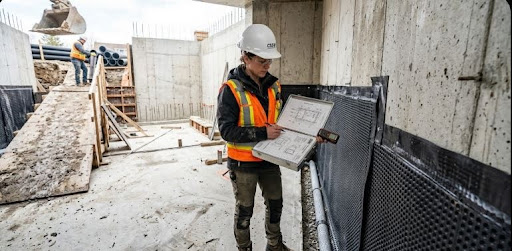
Water gets into buildings. It damages walls, floors, and foundations. Stopping it requires more than good products it requires the right expert.
That expert is a CSSW.
If you are planning a basement conversion, a below-ground extension, or any structure that sits in or near the ground, you need to understand what a CSSW is and why they matter to your project.
What Does CSSW Stand For?
CSSW stands for Certified Surveyor in Structural Waterproofing.
A CSSW is a qualified professional who specialises in designing waterproofing systems for below-ground structures. They assess risk, select the correct system, and produce a formal waterproofing design.
What Does a CSSW Do?
A CSSW does not just recommend a product. They design a complete waterproofing strategy for your specific structure.
Their work includes site assessment, risk evaluation, waterproofing system selection, written design specification, and guidance on installation. They take full design liability for the systems they specify.
In short , they make sure the right waterproofing system is chosen, correctly designed, and properly documented.
Why Does BS 8102:2022 Require a CSSW?
BS 8102 is the British Standard that governs below-ground waterproofing in the UK. The 2022 update introduced a significant change.
It now requires that a CSSW-qualified professional is included in the design team for any below-ground waterproofing project. This applies to new builds and retrofits alike.
Before 2022, waterproofing design was often left to general contractors or product suppliers. The 2022 revision changed that. A certified specialist must now be formally involved.
This reflects the complexity of waterproofing. Getting it wrong is expensive. Getting it right requires specialist knowledge.
What Happens Without a CSSW-Qualified Designer?
Without a CSSW, your project may not comply with BS 8102:2022. Non-compliance creates serious problems.
Building warranty providers ,such as NHBC, LABC, and Premier Guarantee , often require BS 8102 compliance as a condition of cover. A project without a CSSW-produced design may lose its warranty entirely.
Structural defects caused by poor waterproofing design are also difficult and costly to fix. Fixing a failed waterproofing system in a completed basement typically costs more than installing it correctly the first time.
The risk is not just financial. In a residential basement or habitable space, waterproofing failure leads to damp, mould, and structural decay.
CSSW Qualifications: How Does Someone Become a CSSW?
The CSSW qualification is not a short course. It requires demonstrated technical competence and structured assessment.
Candidates must complete a formal training programme covering waterproofing theory, BS 8102 compliance, system selection, site assessment, and design specification. They are assessed on practical knowledge and real-world application.
Continuing professional development is required to maintain the qualification. A CSSW must stay current with changes to standards, products, and building regulations.
This is not a generic construction qualification. It is a specialist waterproofing credential.
Who Issues the CSSW Qualification?
The CSSW qualification is issued by the Property Care Association (PCA).
The PCA is the UK’s leading trade body for the property care sector. It sets competence standards for damp proofing, timber preservation, flood remediation, and structural waterproofing.
When a professional holds a CSSW from the PCA, it means they have passed a recognised assessment in structural waterproofing design. You can verify a CSSW’s credentials directly through the PCA register.
Always check. Not everyone who claims waterproofing expertise holds a formal CSSW qualification.
CSSW vs General Building Surveyor: What’s the Difference?
A general building surveyor inspects properties and identifies defects. They cover a wide range of issues , from roof condition to structural movement to dampness.
A CSSW is different. Their sole focus is structural waterproofing design. They understand the mechanics of water ingress, soil conditions, groundwater pressure, and the technical requirements of Type A, Type B, and Type C systems under BS 8102.
A general building surveyor can identify that a basement has a damp problem. A CSSW determines exactly why it is happening, which system will solve it, and produces a specification that protects you legally and structurally.
For any project involving below-ground waterproofing, a CSSW is the qualified professional you need not a generalist.
Do You Need a CSSW for Your Project?
Here is a straightforward guide.
| Project Type | CSSW Required? | Why |
| New-build basement or underground space | Yes | BS 8102:2022 requires CSSW on design team |
| Basement conversion (existing building) | Yes | Structural waterproofing design needed for planning and warranty |
| Cellar tanking or damp-proofing to cellar | Recommended | Below-ground moisture risk requires proper assessment |
| Ground-floor damp proofing only (DPC) | No | Falls under standard damp proofing, not structural waterproofing |
| Retaining wall waterproofing | Yes | Below-ground structural application under BS 8102 scope |
| Podium deck or underground car park | Yes | Complex below-ground application requiring full CSSW design |
If your project involves any structure below ground level, assume you need a CSSW. The cost of involving one early is significantly lower than the cost of correcting a failed design later.
How a CSSW Produces a Waterproofing Design
A CSSW follows a defined process. Each step builds on the last.
Step 1: Site Assessment. The CSSW visits the site. They assess ground conditions, existing structure, water table levels, and potential contamination risks.
Step 2: Risk Classification. They classify the project against BS 8102:2022 risk categories. This determines the waterproofing grade required — from Grade 1 (basic dry) to Grade 3 (fully habitable).
Step 3: System Selection. Based on risk, they specify the correct system. This could be Type A barrier protection, Type B structurally integral waterproofing, Type C cavity drainage, or a combination.
Step 4: Written Specification. They produce a formal written design. This document details every product, installation method, and quality check required.
Step 5: Design Sign-Off. The CSSW takes formal design liability. If the system is installed to their specification and fails due to a design error, the liability rests with them — not the contractor.
This process protects everyone involved. The homeowner gets a compliant design. The contractor gets clear instructions. The building owner gets a defensible record.
What to Ask Your Waterproofing Contractor About CSSW
Not all waterproofing contractors employ a CSSW. Some use external consultants. Some do not involve one at all.
Before you commit to any waterproofing contract, ask these questions directly.
Is a CSSW producing the waterproofing design for my project?
The answer should be yes. If they hesitate, ask again.
Can I see the CSSW’s PCA registration number?
Any legitimate CSSW will provide this. Verify it on the PCA register.
Will the CSSW take formal design liability?
This is critical. The design liability must sit with the qualified professional — not be passed to the contractor or left unassigned.
Is the design produced to BS 8102:2022?
This is the current standard. Designs produced to the outdated 2009 version may not meet current warranty requirements.
Will I receive a copy of the waterproofing design document?
You should always receive a copy. It is part of your building’s permanent record.
These are not difficult questions. Any reputable contractor will answer them without hesitation.
FAQs:
Is a CSSW the same as a damp proofing surveyor?
No. A damp proofing surveyor inspects for rising damp, penetrating damp, and condensation. A CSSW specialises specifically in structural waterproofing design for below-ground structures. The two roles have different qualifications and scopes.
Can a contractor produce a waterproofing design without a CSSW? Not in compliance with BS 8102:2022. The standard requires a qualified specialist on the design team. A contractor without a CSSW cannot produce a compliant waterproofing design.
Does every basement project need a CSSW? Any project that involves structural waterproofing under BS 8102 requires a CSSW-qualified designer. This includes new-build basements, basement conversions, underground extensions, and most retrofit waterproofing projects on below-ground structures.
How do I find a CSSW near me? Search the PCA’s online member register at the Property Care Association website. Filter by specialism to find CSSW-qualified professionals in your area.
Does a CSSW design affect my building warranty? Yes ,significantly. Most structural warranty providers require BS 8102-compliant waterproofing design as a condition of cover. A CSSW-produced design supports your warranty application and protects you if a dispute arises later.
Conclusion: if your project goes below ground, a CSSW is not optional. They are the qualified professional who ensures your waterproofing system is designed correctly, complies with BS 8102:2022, and protects your structure for decades.
Involve one early. The design stage is where waterproofing projects succeed or fail.