
If you own a property with a basement or cellar in the UK, you already know the risks. Groundwater, rising damp, seasonal rainfall, and ageing structures are a constant threat to below-ground spaces. Yet many homeowners and developers still approach basement waterproofing as an afterthought, choosing the cheapest option without understanding what their project truly needs. That can be a very costly mistake.
This guide breaks down everything you need to know about basement waterproofing systems in the UK: the three main types defined under BS 8102:2022, what they cost in 2025, which system suits your needs, and why getting a qualified CSSW-certified design specialist involved from the start is the single most important decision you can make. Whether you are converting a cellar into a living room or waterproofing a new-build basement, the information here will help you make an informed, confident decision.
Key Stat: The average basement waterproofing cost in the UK is approximately £120 per m². A 4m x 5m basement with 3-metre walls typically costs around £8,000 to waterproof professionally (Source: Checkatrade / B3 Cost Consulting, 2026).
What Is Basement Waterproofing and Why Does It Matter in the UK?
Basement waterproofing is the process of protecting below-ground structures from water ingress, damp penetration, and moisture accumulation. In the UK, where annual rainfall averages over 885mm and groundwater levels can fluctuate dramatically, properties with basements or cellars face a very real risk of water damage if waterproofing is not correctly designed and installed.
Without proper waterproofing, the consequences are serious: structural deterioration, mould growth, timber decay, unhealthy living conditions, and in the worst cases, complete basement flooding that can cost tens of thousands of pounds to remediate. Research shows that amateur or incorrectly specified waterproofing typically fails within 2 to 5 years, triggering remedial work costing anywhere from £20,000 to £40,000.
Waterproofing is not just about keeping a space dry today. It is about protecting a long-term asset. A properly waterproofed basement can add £30,000 to £80,000 to a property value in suburban UK areas, and significantly more in prime London locations.
Understanding BS 8102:2022: The UK Standard That Governs All Basement Waterproofing
BS 8102:2022 (Code of Practice for Protection of Below Ground Structures Against Water Ingress) is the current UK standard that defines how basement waterproofing must be designed, specified, and installed. Updated from the 2009 version and published in March 2022, it represents the most comprehensive set of waterproofing guidelines the UK industry has ever had.
Every responsible basement waterproofing system in the UK today must comply with BS 8102:2022. Mortgage lenders, warranty providers such as NHBC and Premier Guarantee, and building control authorities all require compliance with this standard.
What changed in BS 8102:2022?
- It now requires a named CSSW-qualified waterproofing design specialist to be appointed as part of the design team before the technical design stage (RIBA Stage 4 for new builds).
- The performance grades have been updated to focus on the intended use of the space, not just the structure.
- Greater emphasis is placed on repairability, long-term maintainability, and combined system approaches.
- The standard now explicitly acknowledges that some defects are inherent in materials and requires the design to consider how these can be addressed after construction.
One of the most significant changes is this: you cannot simply appoint any builder or damp-proofing contractor and expect compliance. The standard now mandates specialist design input with professional indemnity insurance. This is where a CSSW-qualified design service like CSSW Design becomes not just valuable but legally and practically essential.
Basement Waterproofing Grades: Matching Protection to Purpose
Before selecting a waterproofing system, BS 8102:2022 requires you to establish the intended use of the below-ground space. It categorises this into four grades of environment:
- Grade 1a – Car Parks and Plant Rooms: Some seepage and damp patches tolerable. Used for non-sensitive applications.
- Grade 1b – Storage Areas: Seepage tolerable but no free water. Suitable for general storage.
- Grade 2 – Workshops and Utility Areas: No seepage acceptable; dampness from condensation only is tolerable.
- Grade 3 – Habitable Rooms and Offices: Completely dry environment required. No moisture penetration of any kind is acceptable. Demands the most robust waterproofing approach, typically combining at least two system types.
Getting the grade right is critical. Over-specifying wastes budget; under-specifying leads to failure. A qualified CSSW design specialist will match the correct grade and system to your specific use case and site conditions.
The Three Types of Basement Waterproofing Systems Explained
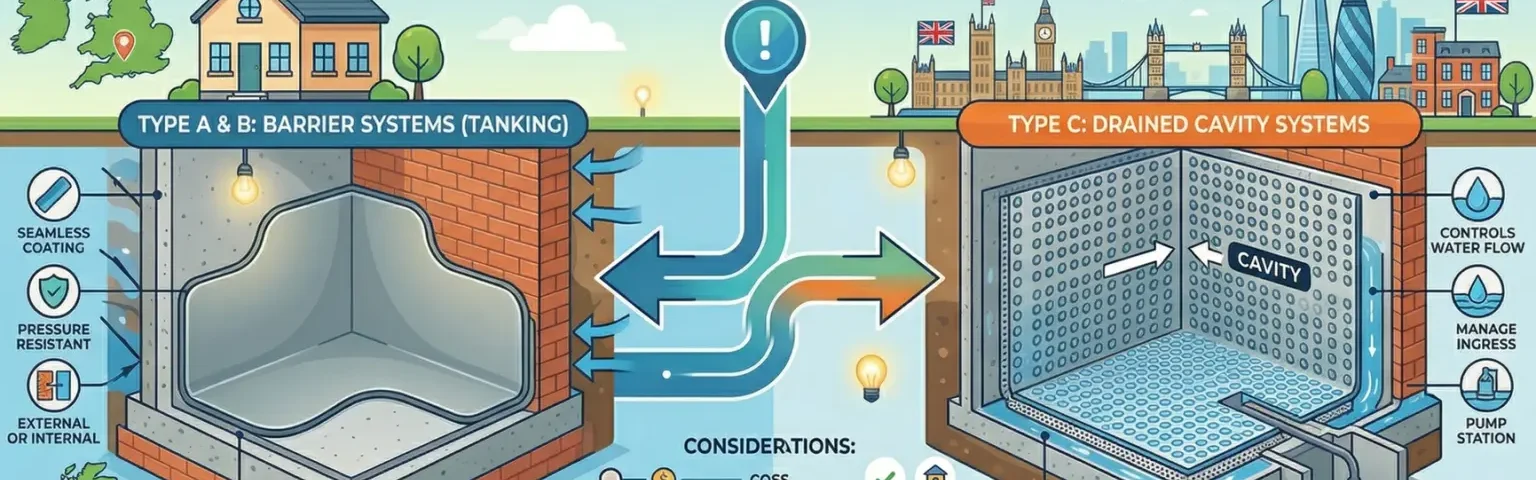
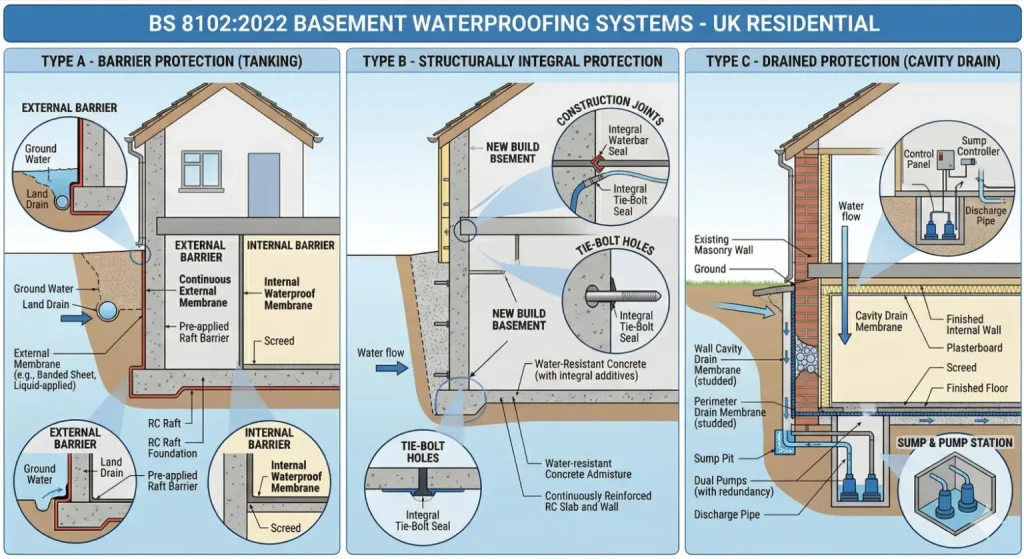
BS 8102:2022 classifies all basement waterproofing systems into three categories. Understanding each type helps you grasp why professional design and specification is so important.
Type A – Barrier Protection (Tanking)
Type A systems form a physical barrier against water ingress. They are applied internally or externally to basement walls and floors using cementitious slurries, crystalline coatings, liquid-applied membranes, or self-adhesive sheet membranes.
Type A is often referred to as tanking. It is the most commonly marketed method for DIY applications, but it carries significant risk as the sole waterproofing strategy. Because the system relies entirely on its own integrity, any breach, crack, or joint failure can result in water getting behind the barrier with no way out. For this reason, BS 8102:2022 recommends that Type A be used in combination with another system type in higher-risk environments.
Typical Type A material costs start from around £40 per m² for cementitious applications up to £50 per m² for specialist waterproof renders, excluding labour and preparation.
Type B – Structurally Integral Protection
Type B uses the structure itself as the waterproofing element. This is achieved through the careful design and placement of waterproof concrete, using controlled pour sequences, hydrophilic waterstops at construction joints, and sometimes crystalline admixtures that react with concrete to permanently seal its pores.
Type B is exclusively a new-build solution. It cannot be retrofitted. When specified and constructed correctly, it provides excellent baseline protection and adds relatively modest cost to the overall structural concrete works, typically £8 to £20 per cubic metre of structural concrete above the standard mix cost.
The critical caveat with Type B is that its effectiveness is entirely dependent on construction quality control. Poor concrete placement, inadequate curing, or incorrect joint detailing will compromise the entire system.
Type C – Cavity Drain (Drained Protection)
Type C systems do not attempt to stop water from entering the structure. Instead, they collect and manage any water that does penetrate, directing it to a sump and pump system that then discharges it safely away from the property.
A studded dimple drainage membrane is fixed to the internal face of the basement walls and floor, creating a discrete cavity that channels any moisture to a perimeter drainage channel and ultimately to the sump chamber. Fully maintained and serviceable, Type C is the most reliable system for retrofitting existing basements and for achieving Grade 3 habitable environments.
Type C cavity drain systems typically cost between £80 and £150 per m² installed, including the drainage membrane, sump, pump, and associated plumbing. For most UK homeowners converting a cellar or retrofitting a waterproofing system, this is the recommended solution.
Quick Reference: Waterproofing System Comparison
| System Type | Method | Best For | Typical Cost/m² |
|---|---|---|---|
| Type A – Barrier (Tanking) | Cementitious slurry, membranes, coatings applied internally or externally | Damp-proof storage, low-risk sites | From £40/m² |
| Type B – Structurally Integral | Waterproof concrete mix design; joints & admixtures | New-build projects only | Added to concrete cost (£8–£20/m³ extra) |
| Type C – Cavity Drain | Dimple membrane + sump & pump system manages water ingress | Habitable rooms, retrofit basements | £80–£150/m² |
Should You Combine Waterproofing System Types?
For Grade 3 habitable basement environments, BS 8102:2022 strongly recommends combining at least two system types to provide redundancy. This is known as a multi-barrier approach.
A common and highly effective combination for both new-build and retrofit projects is Type A (external waterproofing membrane) plus Type C (internal cavity drain). The external barrier handles the primary load; the internal cavity drain manages any residual moisture or unexpected ingress. Together, they create a robust, compliant system with built-in redundancy.
Professional insight: A CSSW-qualified waterproofing designer will always assess your specific site conditions, groundwater data, and intended use before specifying a system. There is no one-size-fits-all answer in structural waterproofing.
Basement Waterproofing Costs in the UK: What to Expect in 2026
Cost is consistently the number one concern for homeowners and developers approaching a basement waterproofing project. Here is a clear, research-backed breakdown of what you can expect to pay in the UK today.
General guide prices (based on industry data from 2025/2026):
Typical Basement Waterproofing Costs by Size (UK 2026)
| Basement Size | Approx. Waterproofing Cost (2026) |
|---|---|
| 4m x 5m (3m high walls) | ~£8,000 |
| 5m x 6m (3m high walls) | ~£10,500 |
| 6m x 7m (3m high walls) | ~£17,500 |
| Per m² guide price | ~£120/m² |
Source: Industry guide prices, B3 Cost Consulting / Checkatrade 2026. Figures exclude VAT and vary by region, access, and system type.
Several key factors can push costs above or below these guide figures:
- System type selected: Type C cavity drain systems are more expensive per m² than basic Type A tanking but far more reliable.
- New build vs. retrofit: Retrofitting an existing basement is generally more expensive due to substrate preparation, access constraints, and the risk of unforeseen conditions.
- Groundwater level and site conditions: High water tables or contaminated ground require more robust and therefore more costly systems.
- Sump pump specification: Adding a dual-pump sump with battery backup significantly increases reliability but adds to the overall project cost.
- Geographic location: London and the South East can carry a 10 to 20% premium compared to other UK regions.
- Access and programme requirements: Complex access, occupied buildings, or tight timescales all increase labour costs.
Why You Need a CSSW-Qualified Waterproofing Design Specialist
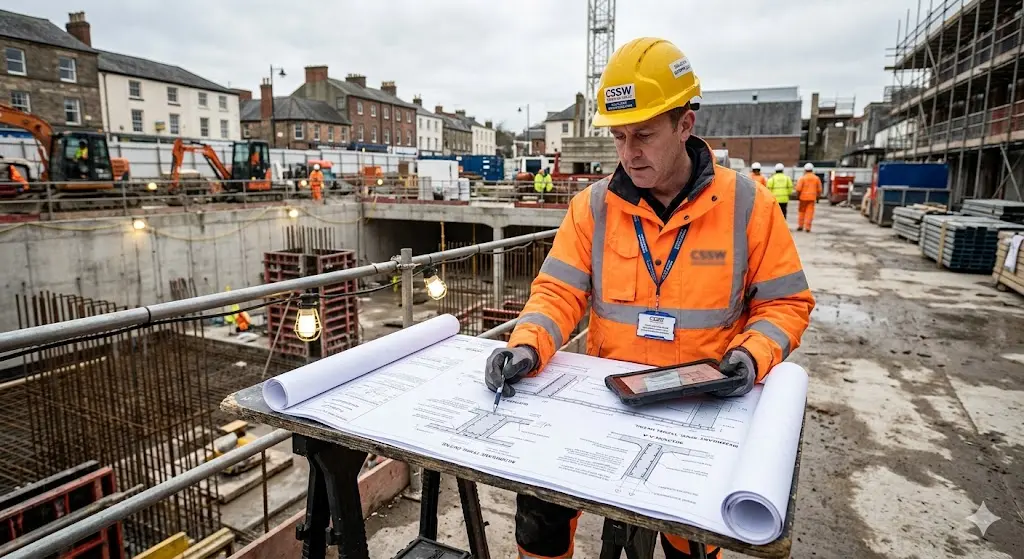
The 2022 revision of BS 8102 made one thing absolutely clear: structural waterproofing is a specialist field and it must be treated as such. Section 4.2 of BS 8102:2022 explicitly requires that a named waterproofing design specialist be appointed to the project team, with the following qualifications:
- Hold at minimum a CSSW (Certificated Surveyor in Structural Waterproofing) qualification.
- Have demonstrable experience relevant to the scale and type of project.
- Carry professional indemnity insurance that covers the design they provide.
- Be capable of designing across all three system types and advising on their buildability, repairability, and maintenance requirements.
At CSSW Design, every basement waterproofing design is produced by a CSSW-qualified specialist. The team operates as an independent design consultancy, meaning the advice and specification provided is never driven by product sales or manufacturer relationships. The design is driven solely by what works best for your site, your project, and your budget.
Engaging a specialist early, at feasibility or concept design stage, consistently delivers better outcomes. Independent studies and industry case reviews show that professional design input costing 8 to 10% of construction budgets typically saves 15 to 20% through smarter specification, prevents costly failures, and ensures the system remains compliant with warranty provider requirements.
Warning Signs Your Basement Needs Waterproofing
Do not wait for a flood before taking action. The following signs indicate that your basement has a water ingress problem that should be assessed by a qualified specialist:
- Persistent damp or musty smell in the basement or cellar.
- Visible mould or mildew growth on walls, floor, or ceiling.
- White powdery deposits (efflorescence) on brick or blockwork surfaces.
- Peeling paint, bubbling plaster, or flaking render on basement walls.
- Standing water or pooling after heavy rain.
- Visible cracks or gaps in walls and floor slab.
- Rust staining on walls or surfaces near metal fixtures.
Any of these issues warrants a proper survey by a qualified CSSW waterproofing design specialist. Early diagnosis and the right system specification can prevent the kind of structural deterioration that costs homeowners tens of thousands to resolve.
New Build Basement Waterproofing vs. Retrofitting an Existing Cellar
New Build Basement Waterproofing
When waterproofing a new-build basement, you have the advantage of access to the external face of the structure before backfilling. This is the optimal scenario technically and from a cost perspective. External Type A membranes and Type B integral concrete systems can be applied efficiently, and the combined cost of the waterproofing works element for a well-specified new-build basement typically ranges from £80,000 to £180,000 for commercial projects of 300 to 600 m² floor plate, covering the full multi-system package.
Retrofit and Cellar Conversion Waterproofing
Retrofitting waterproofing into an existing basement or converting a cellar into a habitable room is more complex and more costly per m². Because the external face is inaccessible, all works must be undertaken internally. Substrate preparation is more intensive, and there is always a risk of encountering unforeseen conditions such as previous repairs, hidden voids, or service penetrations.
Internal cementitious tanking for a retrofit basement with sound concrete typically costs £60 to £100 per m². A full Type C cavity drain system for a retrofit cellar conversion, including sump and pump, typically costs £80 to £150 per m². Standard basement conversions in the UK cost between £1,350 and £1,700 per m² overall, with waterproofing representing 15 to 20% of the total project budget.
Frequently Asked Questions About Basement Waterproofing in the UK
1. Do I legally need a CSSW specialist to waterproof my basement in the UK?
Under BS 8102:2022, it is strongly recommended that a CSSW-qualified specialist is appointed as the waterproofing designer. While it is not a statutory legal requirement on its own, most third-party warranty providers (NHBC, Premier Guarantee, LABC) now require it, and mortgage lenders increasingly expect BS 8102:2022 compliance evidence. Failing to appoint a specialist also exposes you to significant financial and structural risk.
2. What is the difference between tanking and waterproofing?
Tanking is a specific type of waterproofing, classified as Type A under BS 8102:2022. It involves applying a waterproof barrier coating or membrane to walls and floors. Waterproofing is the broader term covering all three system types: Type A (barrier/tanking), Type B (structural integrity), and Type C (cavity drain). Tanking alone is often insufficient as the sole waterproofing measure for habitable basement environments.
3. How long does basement waterproofing last?
A professionally designed and installed basement waterproofing system, particularly a Type C cavity drain system, should last the life of the building when properly maintained. Most reputable UK contractors and design firms offer 10-year installation guarantees, with options for 25-year system warranties and insurance-backed guarantees available through approved installers.
4. Can I waterproof a basement myself?
Simple applications of basic damp-proof products are possible for DIY. However, for any significant waterproofing project, particularly one intended to create a habitable room, professional design and installation is strongly advised. Amateur waterproofing regularly fails within 2 to 5 years, and remedial works to correct failures typically cost £20,000 to £40,000. The savings from DIY rarely justify the risk.
5. How much does a basement waterproofing survey cost?
Most reputable waterproofing specialists will carry out an initial survey free of charge or include it as part of the design service. Where a survey fee is charged independently, you can typically expect to pay between £100 and £200.
6. Which is better: internal or external waterproofing?
External waterproofing is generally considered the more effective approach because it protects the structure from the outside before water can penetrate. However, it is only accessible on new-build or major renovation projects before backfilling. For existing basements, internal systems, particularly Type C cavity drain, are the practical and highly effective solution. Most complex projects will use both.
7. Does basement waterproofing add value to my property?
Yes, significantly. A professionally waterproofed and converted basement adds £30,000 to £80,000 to property values in suburban UK areas. In prime London locations, the value uplift can be considerably higher. The cost per m² to create usable basement space (£2,000 to £3,000 for full conversions) is consistently lower than the resale value created (£3,000 to £5,000/m² in premium areas).
8. Do I need planning permission to waterproof my basement?
Waterproofing an existing basement generally does not require planning permission if it does not alter the external appearance of the property. However, converting a basement into a habitable room, installing a new lightwell, or significantly changing the use of the space may trigger a planning requirement. A planning application in the UK currently costs approximately £206. Always consult your local planning authority before starting works.
Final Thoughts: Get the Design Right Before You Commit
Basement waterproofing is one of the most technically demanding and financially significant decisions any property owner will make. The difference between a basement that remains dry and usable for decades and one that fails within a few years almost always comes down to the quality of the design and specification, not just the materials used.
The right system, selected by a qualified CSSW specialist with full professional indemnity, matched to your site conditions and intended use, and installed by an approved contractor, will deliver long-term performance, full compliance with BS 8102:2022, and complete peace of mind. Do not let cost-cutting at the design stage become the most expensive decision you ever make.
To find out which basement waterproofing system is right for your project and get a fully compliant BS 8102:2022 design, speak with the specialist team at CSSW Design today.