
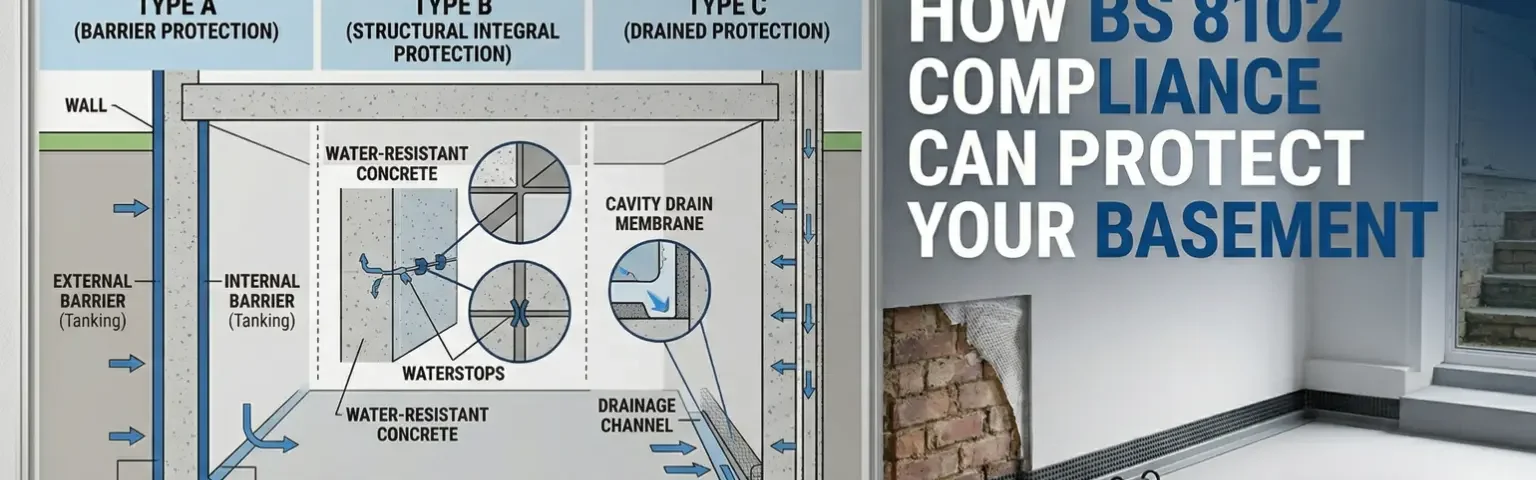
If you are planning a basement conversion, waterproofing a new-build structure, or dealing with an existing damp problem below ground, you will almost certainly come across BS 8102:2022. It is the UK’s definitive code of practice for protecting below-ground structures from water ingress, and compliance with it is now expected by building control authorities, mortgage lenders, and third-party warranty providers including NHBC and Premier Guarantee. More importantly, a BS 8102-compliant waterproofing system is the most reliable way to keep your basement dry, safe, and structurally sound for its entire lifespan.
This guide explains what BS 8102 compliance actually means, why it matters for your project, and how to make sure your basement is protected the right way from the start.
What Is BS 8102 and Why Does It Matter?
BS 8102:2022, formally titled Protection of Below Ground Structures Against Water Ingress, is the British Standard that governs how waterproofing systems for basements, cellars, underground car parks, and other below-ground spaces must be designed, specified, and installed in the UK.
It is not a minor technical guideline. Building Regulations Approved Document C specifically references BS 8102 when dealing with basements where walls and floors are subject to water pressure. Warranty providers will withhold cover if a project fails to comply. Insurers increasingly factor compliance into their risk assessments, and in some cases non-compliant waterproofing can affect your ability to sell or remortgage a property.
In short: if your basement is not designed to BS 8102, it is not properly protected, and it may not be legally or commercially insurable. Working with a CSSW-qualified design specialist like CSSW Design is the most reliable way to ensure full compliance from day one.
Key Changes in the BS 8102:2022 Update
The 2009 version of BS 8102 served the industry for over a decade. The 2022 revision was not cosmetic. It introduced substantive changes that directly affect how every basement waterproofing project in the UK must be approached:
- A named waterproofing design specialist is now required. Section 4.2 of BS 8102:2022 explicitly requires a suitably qualified specialist, at minimum, a Certificated Surveyor in Structural Waterproofing (CSSW), to be appointed to the design team before the technical design stage begins.
- Risk assessment is now central. Designers must document a full risk assessment of site conditions before selecting any waterproofing system. This includes groundwater levels, flood risk, soil type, radon, methane, and other ground gas data.
- Performance grades have been updated. The grades now focus on the intended use of the space rather than just structural characteristics, making it easier to match the right level of protection to the actual environment.
- Combined systems are strongly recommended for high-risk environments. For Grade 3 habitable spaces, the standard recommends using at least two system types to provide redundancy and reduce the risk of total failure.
- Sandwich waterproofing has been removed as an acceptable Type A position, tightening the specification rules for barrier systems.
- Maintenance and repairability are now explicitly addressed. The standard requires designers to consider how the system will be inspected, maintained, and repaired throughout its design life.
Key insight: The 2022 update makes it clear that waterproofing can no longer be an afterthought added at the end of a project. It must be designed in from the very start by a qualified specialist.
The Four BS 8102 Performance Grades Explained
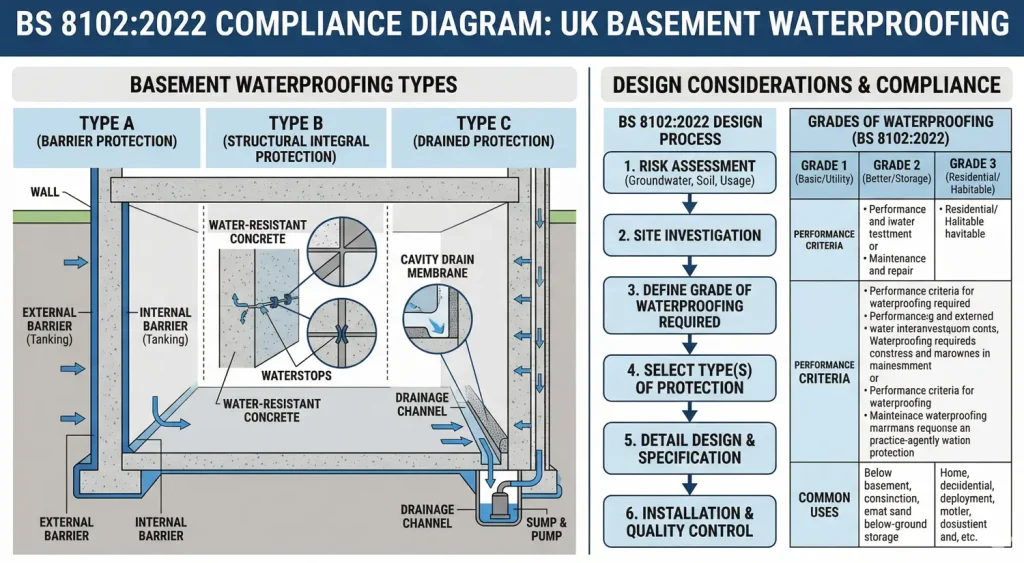
Before specifying any waterproofing system, BS 8102:2022 requires the project team to establish the required performance grade for the space. The grade defines the acceptable level of moisture and directly determines which system or combination of systems must be used.
BS 8102:2022 Performance Grades at a Glance
| Grade | Acceptable Moisture Level | Typical Use & System Required |
|---|---|---|
| Grade 1a | Seepage and damp areas tolerable | Car parks, plant rooms, Type A or C |
| Grade 1b | No seepage; damp areas tolerable | General storage, Type A or C |
| Grade 2 | No seepage; condensation damp only | Workshops, utility areas, Type A or C |
| Grade 3 | No water ingress or damp of any kind | Habitable rooms, offices, combined Type A + C or A + B + C |
Source: BS 8102:2022, Code of Practice for Protection of Below Ground Structures Against Water Ingress
Selecting the wrong grade, particularly under-specifying for a space that will be used as a habitable room, is one of the most common causes of waterproofing failure in UK basement projects. A CSSW design specialist will establish the correct grade based on your intended use and site conditions before any system is selected.
How BS 8102 Compliance Directly Protects Your Basement
Compliance with BS 8102:2022 is not a bureaucratic exercise. Each requirement within the standard exists because a real waterproofing failure has demonstrated why it matters. Here is what compliance actually protects you against:
Structural Deterioration
Water entering a basement structure corrodes reinforcement steel, degrades concrete, promotes carbonation, and over time can compromise the structural integrity of the entire below-ground construction. BS 8102-compliant systems are designed to prevent water from reaching the structure at all, or to manage it safely so it never builds up hydrostatic pressure against the fabric of the building.
Mould, Damp, and Unhealthy Conditions
Persistent moisture in a below-ground space is the primary cause of mould growth, timber decay, and air quality problems. A properly graded, BS 8102-compliant waterproofing system eliminates the moisture source rather than masking it, producing a genuinely dry and healthy environment.
Warranty and Insurance Voids
Most major third-party warranty providers, NHBC, LABC Warranty, Premier Guarantee, now require BS 8102:2022 compliance as a condition of cover. Without it, any remedial claim for water ingress may be rejected. A compliant system, installed by an approved contractor and backed by a 10-year installation guarantee, keeps your coverage intact and your investment protected.
Property Value and Saleability
A basement that cannot demonstrate BS 8102-compliant waterproofing will raise flags during surveys when you come to sell or remortgage. Conversely, a properly designed and documented waterproof basement adds measurable value, typically £30,000 to £80,000 in suburban UK locations, and significantly more in prime city areas, and gives buyers and lenders the confidence they need.
The Role of a CSSW-Qualified Waterproofing Design Specialist
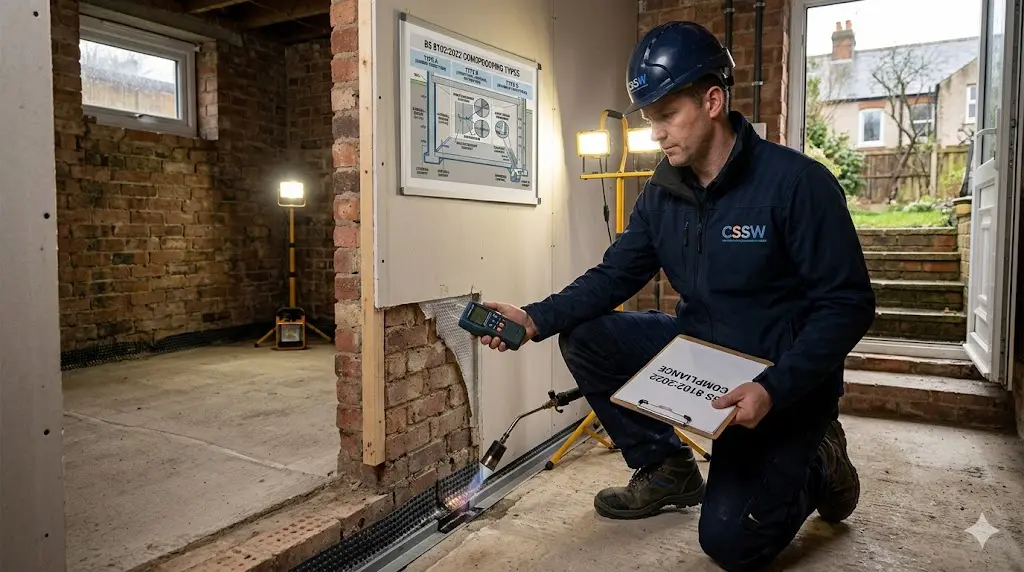
The most significant change introduced by BS 8102:2022 is the formal requirement for a named, CSSW-qualified specialist on every below-ground waterproofing project. This is not optional for projects requiring warranty coverage or building control sign-off. The specialist must carry professional indemnity insurance for the design they provide, be demonstrably experienced in the type and scale of project, and be capable of advising across all three system types.
At CSSW Design, all waterproofing designs are produced independently by CSSW-qualified professionals. This means the specification is driven entirely by what is right for your site, your structure, and your budget, not by product sales or manufacturer relationships. The design includes marked-up CAD drawings, site-specific details at key junctions (doors, windows, drainage), and a full written report that gives you everything needed to obtain like-for-like contractor quotes.
Early engagement consistently delivers better results. Engaging a specialist at feasibility or RIBA Stage 1 rather than at construction stage prevents the costly specification changes and remedial works that account for the majority of waterproofing failures. Learn more about how we approach basement waterproofing design at csswdesign.co.uk.
What Happens If Your Basement Is Not BS 8102 Compliant?
Non-compliance carries real financial and structural consequences that are worth understanding before you commit to any contractor or specification:
- Warranty providers can refuse to cover water ingress claims, leaving you liable for the full cost of remediation.
- Mortgage lenders may require proof of compliant waterproofing design before releasing funds on a property with a converted basement.
- Building control may not sign off on the works, leaving you with an unregistered conversion that is difficult to insure or sell.
- Amateur or incorrectly specified waterproofing regularly fails within 2 to 5 years. Remediation of a failed system typically costs £20,000 to £40,000, not including consequential damage to finishes and contents.
- In the event of a dispute with a contractor, you have significantly less legal recourse if the works were not carried out to a recognised standard.
Frequently Asked Questions About BS 8102 Compliance
What does BS 8102:2022 compliance mean for a homeowner?
It means your basement waterproofing has been designed by a qualified specialist, matched to the correct performance grade for your intended use, and installed using a system that meets the UK’s current code of practice. This protects your structure, your warranty, and your property value.
Is BS 8102 a legal requirement?
It is not a standalone statutory regulation, but Building Regulations Approved Document C references it directly, and compliance is required by NHBC, Premier Guarantee, LABC, and most mortgage lenders for below-ground residential construction. In practice, it is effectively mandatory for any project requiring building control or warranty sign-off.
What is Grade 3 waterproofing?
Grade 3 is the highest level of protection under BS 8102:2022. It requires a completely dry internal environment with no water ingress or damp patches of any kind. It is required for all habitable basement rooms and typically demands a combined waterproofing approach using at least two system types.
Who is qualified to design a BS 8102-compliant system?
The standard requires a CSSW (Certificated Surveyor in Structural Waterproofing) qualified specialist who carries professional indemnity insurance. CSSW Design provides fully independent, CSSW-qualified design services across the UK.
Can I use a general builder for BS 8102-compliant waterproofing?
No. The 2022 revision specifically requires a named waterproofing design specialist on the project team. A general contractor cannot fulfil this role. Installation can be carried out by an approved contractor, but the design and specification must come from a CSSW-qualified professional.
What are the three types of waterproofing under BS 8102?
Type A is barrier protection (tanking, membranes and coatings). Type B is structurally integral protection (waterproof concrete, new build only). Type C is drained protection (cavity drain membrane and sump pump system). For Grade 3 environments, combining two or more types is recommended.
Does BS 8102 apply to existing basements and cellar conversions?
Yes. BS 8102:2022 applies to both new-build and retrofit projects. The 2022 revision includes a significantly expanded section on the inspection and waterproofing of existing below-ground structures, making it directly relevant to cellar conversions and remedial basement works.
How long does a BS 8102-compliant waterproofing system last?
A professionally designed and installed compliant system should last the design life of the building. Most reputable installers back their work with a 10-year installation guarantee, with options for 25-year system warranties and insurance-backed guarantees available through approved contractors.
Does BS 8102 compliance add value to my property?
Yes. A documented, compliant basement waterproofing system gives buyers, surveyors, and lenders confidence. It removes a significant red flag during conveyancing and contributes directly to the value uplift delivered by a quality basement conversion.
How do I get a BS 8102-compliant design for my project?
Contact a CSSW-qualified specialist at the earliest stage of your project, ideally before any contractor quotes are sought. CSSW Design provides independent structural waterproofing design across the UK, fully compliant with BS 8102:2022 and backed by professional indemnity insurance.
Get Your Basement Waterproofing Right from the Start
BS 8102:2022 compliance is not a box-ticking exercise. It is the framework that separates a basement that remains dry and protected for decades from one that fails and costs a fortune to put right. The standard exists because every requirement in it reflects a real-world failure that has caused real damage to real properties.
The most important step you can take on any below-ground project is to appoint a qualified waterproofing design specialist before any other decision is made. At CSSW Design, our CSSW-qualified team provides fully independent, BS 8102:2022-compliant structural waterproofing designs for residential and commercial projects across the UK. Get in touch today for an independent design consultation.