
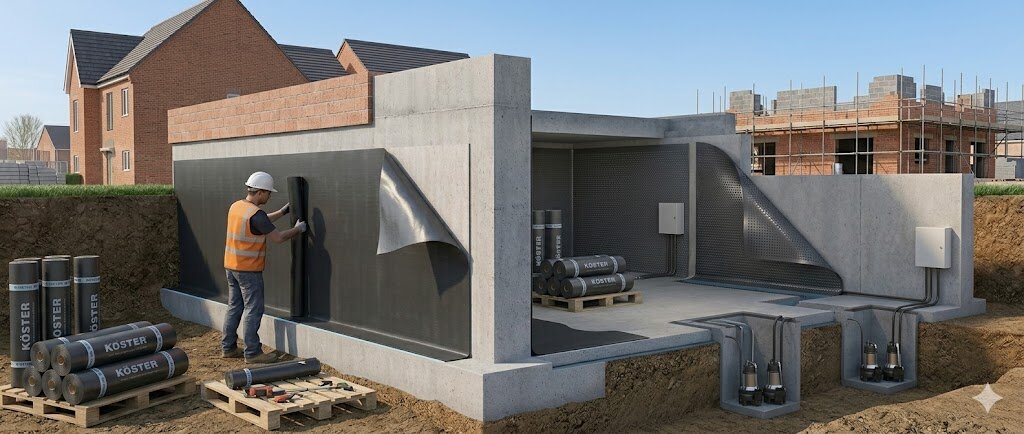
If you are building a new property with a basement, lower ground floor, or any below-ground space, waterproofing needs to be part of the design from day one. Not after the concrete is poured. Not when the contractor asks about it on site. From day one.
New build waterproofing in the UK is governed by BS 8102:2022, the British Standard for protecting below-ground structures from water ingress. It requires a qualified specialist to be named on the design team before construction begins, and it defines exactly which systems must be used depending on how the space will be used. This guide explains the systems available, what they cost, when each one applies, and how to make sure your new build is protected correctly from the foundation up.
Why New Build Waterproofing Is Different from Retrofit
When you are waterproofing a new build, you have access to the external face of the structure before backfilling. That is the single biggest advantage over retrofit projects, where the external face is buried and inaccessible without expensive excavation.
This access means you can apply the most effective waterproofing, directly to the outside of the concrete structure, before the ground is reinstated around it. It also means you can design the waterproof concrete mix from the start rather than trying to address water ingress after the fact. Done properly, a new build basement is one of the easiest below-ground spaces to waterproof well. Done poorly or as an afterthought, it is one of the most expensive to fix.
Industry data confirms this clearly: amateur or incorrectly specified waterproofing in new build basements typically fails within 2 to 5 years, and remediation of a failed system costs £20,000 to £40,000 before any consequential damage to finishes or contents is accounted for.
The best time to get waterproofing right on a new build is before construction starts. Appointing a CSSW-qualified design specialist at the design stage consistently prevents the most expensive problems.
The Three Waterproofing Systems for New Builds
Under BS 8102:2022, there are three recognised types of waterproofing system. For new build projects, all three are available and can be used individually or in combination depending on the intended use of the space and the site conditions.
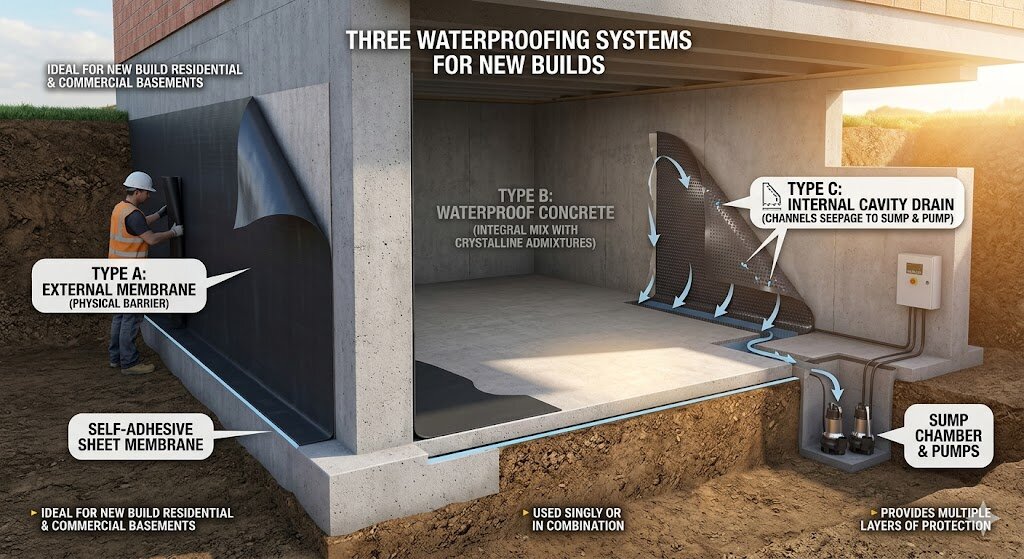
Type A: External Waterproof Membrane
A Type A system forms a physical barrier on the outside face of the structure. On a new build, it is typically applied as a self-adhesive sheet membrane, a liquid-applied membrane, or a torch-on bituminous membrane to the external walls and floor slab before backfilling begins.
This is the ideal position for a waterproof barrier, on the water-facing side of the structure, where it can prevent water from reaching the concrete at all. Type A external membranes add approximately £40 to £80 per m² to the construction cost and are widely used as the primary waterproofing layer on new build residential and commercial basements across the UK.
Type B: Waterproof Concrete
A Type B system uses the concrete structure itself as the waterproofing element. Rather than applying a separate membrane, the concrete mix is designed to be watertight from the outset using controlled mix designs, crystalline admixtures that react with the concrete to seal its pores, and hydrophilic waterstops at all construction joints.
Type B is exclusively a new build solution, it cannot be retrofitted into an existing structure. When specified and built correctly, it provides strong baseline protection at a relatively modest cost: typically £8 to £20 per m³ of structural concrete above the standard mix price. The critical factor is quality control on site. Poor concrete placement, inadequate curing, or poorly detailed construction joints will undermine the system entirely, which is why specialist design input is essential.
Type C: Internal Cavity Drain with Sump and Pump
A Type C system does not try to stop water from entering the structure. Instead, it collects any water that does get in and channels it safely away via a dimple drainage membrane, a perimeter drainage channel, and a sump and pump system.
On new build projects, a Type C system is typically installed internally after the structure is complete. It costs approximately £80 to £150 per m² installed, including the sump chamber, pump, alarm, and non-return valve. For Grade 3 habitable environments, a dual-pump sump with battery backup is strongly recommended, adding approximately £800 to £1,500 to the sump cost.
Type C is used on new builds primarily as a second line of defence, providing redundancy in case the external membrane or waterproof concrete has a defect. For Grade 3 spaces, combining Type A external membrane with Type C internal cavity drain is the most widely used and reliable approach.
Waterproofing Systems for New Builds: At a Glance
| System | How It Works | Best Use | Approx. Added Cost |
|---|---|---|---|
| Type A (external membrane) | Waterproof membrane applied to outside of structure before backfill | New build, all grades | £40 to £80 per m² |
| Type B (waterproof concrete) | Admixtures and waterstops in the concrete mix itself | New build only | £8 to £20 per m³ of concrete |
| Type C (cavity drain) | Internal dimple membrane channels water to sump pump | All grades, essential for Grade 3 | £80 to £150 per m² |
| Combined A + B + C | Full multi-layer defence in depth | Grade 3 habitable, high-risk sites | Project specific |
Guide costs exclude VAT. Actual costs depend on system specification, groundwater conditions, basement size, and location. Source: MPS Concrete, Premcrete, Checkatrade / B3 Cost Consulting 2025.
Which System Does Your New Build Need?
The right system or combination of systems depends on two things: the performance grade required for the intended use of the space, and the specific groundwater and soil conditions on your site.
For storage or utility areas where some damp is tolerable (Grade 1 and 2 under BS 8102:2022), a Type A external membrane combined with Type B waterproof concrete is often sufficient. For any habitable space, a bedroom, home office, gym, or living room, Grade 3 applies and the standard strongly recommends at least two system types combined to provide redundancy.
The most common and reliable combination for a new build habitable basement in the UK is a Type A external membrane applied before backfill, waterproof concrete (Type B) in the structural mix, and a Type C cavity drain system installed internally. This multi-layer approach means that if any single element has a defect, the others provide backup protection. It satisfies BS 8102:2022, meets NHBC and Premier Guarantee warranty requirements, and gives building control everything it needs for sign-off.
Your CSSW-qualified waterproofing design specialist will carry out a site-specific risk assessment covering groundwater levels, seasonal water table fluctuation, flood risk zone, and soil type before recommending the correct system combination for your project.
What BS 8102:2022 Requires for New Build Projects
Every new build basement waterproofing project in the UK must comply with BS 8102:2022. The 2022 revision made compliance more demanding in one key area: it now requires a named, CSSW-qualified waterproofing design specialist to be appointed to the project team at RIBA Stage 4 or earlier.
This is not a minor administrative step. It means the waterproofing system must be independently designed by a specialist who holds the Certificated Surveyor in Structural Waterproofing qualification, carries professional indemnity insurance covering the design, and has demonstrable experience on projects of the relevant type and scale.
For new build projects, warranty providers including NHBC, Premier Guarantee, and LABC now require evidence of BS 8102:2022 compliance as a condition of cover. Building control authorities also expect the waterproofing specification to reference the standard. Without this, your project may not achieve the sign-off or warranty coverage you need.
Common Mistakes in New Build Waterproofing and How to Avoid Them
New build waterproofing failures are not random. They follow a predictable pattern of the same mistakes made repeatedly. Here are the most common ones and how to avoid them:
- Treating waterproofing as a late-stage decision. Waterproofing must be designed into the project from the outset. Specifying it at construction stage means the opportunity for the most cost-effective solutions has already passed.
- Relying on the main contractor to specify the system. Contractors who supply and install waterproofing products have a financial interest in recommending those products. Independent design avoids this conflict entirely.
- Underspecifying for the intended use. Specifying a storage-grade system for a space that will become a habitable room is one of the most frequent causes of expensive remedial work.
- Poor quality control on waterproof concrete. Type B systems fail when concrete is poorly placed, inadequately cured, or when construction joints are not detailed and formed correctly. Specialist oversight during construction is essential.
- No redundancy on high-risk sites. Using a single system on a site with a high or variable water table without a backup system means that any failure results in immediate water ingress with no fallback protection.
- Skipping the sump pump backup. For any habitable basement, a single pump with no battery backup is an unacceptable risk. Power cuts and pump failures happen. A dual-pump system with battery backup costs relatively little compared to the damage a flooded basement causes.
Getting independent waterproofing design right at the start typically costs 8 to 10% of the waterproofing budget and consistently saves 15 to 20% overall by preventing over-specification, remedial works, and construction-stage changes.
How to Appoint the Right Waterproofing Specialist for Your New Build
The most important step for any new build project with a below-ground element is appointing an independent, CSSW-qualified waterproofing design specialist before approaching contractors. At CSSW Design, all structural waterproofing designs are produced by CSSW-qualified professionals, are fully compliant with BS 8102:2022, and are backed by professional indemnity insurance.
An independent design gives you three things that a contractor-led specification cannot: a system chosen purely on merit for your site conditions, a document that satisfies warranty providers and building control, and a basis for obtaining genuine like-for-like competitive quotes from approved installers.
When selecting an installer, look for Property Care Association (PCA) membership, BBA-approved materials, and a minimum 10-year installation guarantee backed by an insurance-backed guarantee. Engage your waterproofing design specialist at the earliest design stage, ideally at RIBA Stage 2 or 3, to ensure the waterproofing strategy is built into the structural and architectural design from the beginning.
Start with the Right Design and Your New Build Basement Will Stay Dry
New build waterproofing is a technical field with a clearly defined standard, well-established system types, and a predictable set of failure modes. The projects that succeed are the ones where a qualified specialist is involved from the start, the system is chosen for the site rather than for convenience, and quality control is maintained through the construction process.
If you are planning a new build with a basement or any below-ground space, the first call to make is to an independent CSSW-qualified waterproofing design specialist. Get in touch with the team at CSSW Design today for an independent design consultation and a specification that protects your project from the ground up.
Frequently Asked Questions: Waterproofing for New Builds in the UK
What is the best waterproofing system for a new build basement?
For a habitable new build basement, the most reliable approach is a Type A external membrane applied before backfilling, combined with Type B waterproof concrete and a Type C internal cavity drain system. This multi-layer combination satisfies BS 8102:2022 Grade 3 requirements and provides built-in redundancy.
When should waterproofing be designed for a new build?
Waterproofing should be designed and specified by a CSSW-qualified specialist no later than RIBA Stage 4 (technical design), and ideally from Stage 2 or 3. Starting at the design stage allows the waterproofing strategy to be fully integrated into the structural and architectural design, which is both more effective and more cost-efficient.
Is BS 8102:2022 compliance mandatory for new builds?
Compliance is required by NHBC, Premier Guarantee, LABC, and most major mortgage lenders as a condition of warranty cover and loan approval. Building Regulations Approved Document C also references BS 8102, making compliance effectively mandatory for any new build basement project seeking sign-off.
How much does new build basement waterproofing cost?
A Type A external membrane adds approximately £40 to £80 per m². Type B waterproof concrete adds £8 to £20 per m³ of structural concrete. A Type C cavity drain system installed internally costs £80 to £150 per m². A full combined system for a Grade 3 habitable new build basement typically costs between £80,000 and £180,000 for a 300 to 600 m² commercial floor plate, or proportionally less for residential projects.
Can waterproofing be added to a new build after construction?
Partially. External waterproofing cannot be added after backfilling without expensive excavation. Type B waterproof concrete cannot be retrofitted at all. Internal Type C cavity drain systems can be installed after construction, but adding them retrospectively is more costly than designing them in from the start and means the external protection has already been lost.
What does a CSSW specialist do on a new build project?
A CSSW-qualified specialist carries out a site risk assessment, specifies the correct waterproofing system or combination of systems for the intended use and site conditions, produces CAD drawings and junction details, and provides a written design report that satisfies building control, warranty providers, and installers.
Does new build waterproofing require building control approval?
Yes. Basement waterproofing works form part of the building regulations compliance process for any new build with a below-ground habitable space. Building control will expect the waterproofing specification to reference BS 8102:2022 and to have been designed by a qualified specialist.
What is the difference between Type A, B, and C waterproofing?
Type A is a physical barrier applied as a membrane or coating. Type B uses the concrete structure itself as the waterproofing element. Type C manages water that enters by draining it to a sump and pump. For new builds, all three are available and are often used together for maximum protection.
How long does new build basement waterproofing last?
A correctly specified and installed system should last the full design life of the building. Most reputable contractors offer a 10-year installation guarantee. Insurance-backed guarantees extending to 25 years are available through some approved programmes when the system is designed and installed by accredited parties.
How do I get a waterproofing design for my new build project?
Contact an independent CSSW-qualified design specialist as early as possible in your project. CSSW Design provides independent structural waterproofing design for residential and commercial new builds across the UK, fully compliant with BS 8102:2022 and backed by professional indemnity insurance.